February 28, 2006
Pirate Radio Station
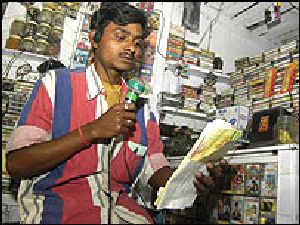
Very cool story from the BBC about Raghav Mahato and his $1 FM radio station: (DIY means do-it-yourself - ie: home built)The amazing DIY village FM radio stationScrew trying to get internet to these areas (there are some people spending a lot of effort working on cheap small internet terminals), simple old radio is much more cost-effective and carries the programming that people really want. We should be drop-shipping hundreds of small FM stations to India, China (the government would just love us...), Iran, Iraq, South America. Leave them in the hands of the people and see what happens. Here is Sambhu the DJ and Announcer:
It may well be the only village FM radio station on the Asian sub-continent. It is certainly illegal.
The transmission equipment, costing just over $1, may be the cheapest in the world.
But the local people definitely love it.
On a balmy morning in India's northern state of Bihar, young Raghav Mahato gets ready to fire up his home-grown FM radio station.
Thousands of villagers, living in a 20km (12 miles) radius of Raghav's small repair shop and radio station in Mansoorpur village in Vaishali district, tune their $5 radio sets to catch their favourite station.
After the crackle of static, a young, confident voice floats up the radio waves.
"Good morning! Welcome to Raghav FM Mansoorpur 1! Now listen to your favourite songs," announces anchor and friend Sambhu into a sellotape-plastered microphone surrounded by racks of local music tapes.
For the next 12 hours, Raghav Mahato's outback FM radio station plays films songs and broadcasts public interest messages on HIV and polio, and even snappy local news, including alerts on missing children and the opening of local shops.
Raghav and his friend run the indigenous radio station out of Raghav's thatched-roof Priya Electronics Shop.
A quick word to commenters
When you post a comment, it shows up even if you don't see it immediately. I offer as a classic example these thirteen identical comments delivered over a 19 minute period by a Mr. Henry A Albagli. Here is the comment repeated once, unedited for your edification:this is going to sound crazy but read this with an open mind. to begin i will say ive seen ufo's twice, the first time was in the early 1980's, i was driving my truck at about 8 pm, i was traveling towards the san gabriel mountains.just outside of los angeles in calif. when out of the sky fell a white circular light, it seemed ''out of control'' looking like a ball in a pin ball machine, going from left to right, right to left, up and down and in all directions in between in lasted for about 15 seconds, i pulled to the side of the road and this circular light went straight up and disapeared, when i got back in my truck there was a circular light that appeared within a few feet from my truck, except this time it was very small maybe only a centameter or so, it was moving as if it was floating down ward, i got out of my truck and tried to let it fall into my hand but it seemed it just kept avoiding my hand like when two magnits are both negative they seem to push off each other, well i was memorized to say the least, i kept watching it and it landed on the grass, when it hit the grass the light turnrd into some kind of liquid light, it seemed it was a combination of water and maybe mercury or liquid silver, and it just stayed stationary in a circular form at the tip of a blade of grass. i went to touch it but when i was just to place my finger on it i started getting very cold at the same time the object started changing form again, it was now about 5 feet tall and about 2 feet wide,it looked like a ''mirage'' you know what you see in the desert from the heat rising up off the ground where you view is waves of distorted air, it seemed to now cover me and i coulden't move not a muscle when i tried the effect was more intence,then i saw something alive coming at me it was a light in the shape of centapede like bug, i felt it was tring to get me to relax and to just be calm, it was like trying to tell me something thats when i closed my eyes and felt it on my forehead starting to communicate with me, i dont remember much except these three things , 1)QUANTUM, 2)JENNY RENDAL and 3)PAUL McCARTNEY, at the time it made perfect sence, i remember thinking '' yes yes yes'' but when you ask me today what this means the only thing i can think of is ''im nuts'' after all out of the three things i remember the only one im familiar with is paul mccartney, heck i dont know maybe paul and jenny are going to have a baby and its name will be quantum and he will be the messiah but regardless how crazy this sounds i will swear on my eyes now that ufo's are out there and they are very inteligent. who ever can figure the meaning of jen ren, sir paul and quatum please tell me . thank youThe post that Mr. Albagli was commenting on was this: UFOs a waste of time Here is a pictorial indication of Mr. Albagli's persistence as seen from my side of the blog:

China, its economics and its people
A very interesting read on the current state of China and where it might be going. From Foreign PolicyThe Dark Side of China’s RiseThe rest of the article is well worth reading. The next five or ten years should show if this is true or not.
China’s economic boom has dazzled investors and captivated the world. But beyond the new high-rises and churning factories lie rampant corruption, vast waste, and an elite with little interest in making things better. Forget political reform. China’s future will be decay, not democracy.
The only thing rising faster than China is the hype about China. In January, the People’s Republic’s gross domestic product (GDP) exceeded that of Britain and France, making China the world’s fourth-largest economy. In December, it was announced that China replaced the United States as the world’s largest exporter of technology goods. Many experts predict that the Chinese economy will be second only to the United States by 2020, and possibly surpass it by 2050.
Western investors hail China’s strong economic fundamentals—notably a high savings rate, huge labor pool, and powerful work ethic—and willingly gloss over its imperfections. Businesspeople talk about China’s being simultaneously the world’s greatest manufacturer and its greatest market. Private equity firms are scouring the Middle Kingdom for acquisitions. Chinese Internet companies are fetching dot-com-era prices on the NASDAQ. Some of the world’s leading financial institutions, including Bank of America, Citibank, and HSBC, have bet billions on the country’s financial future by acquiring minority stakes in China’s state-controlled banks, even though many of them are technically insolvent. Not to be left out, every global automobile giant has built or is planning new facilities in China, despite a flooded market and plunging profit margins.
And why shouldn’t they believe the hype? The record of China’s growth over the past two decades has proved pessimists wrong and optimists not optimistic enough. But before we all start learning Chinese and marveling at the accomplishments of the Chinese Communist Party, we might want to pause for a moment. Upon close examination, China’s record loses some of its luster. China’s economic performance since 1979, for example, is actually less impressive than that of its East Asian neighbors, such as Japan, South Korea, and Taiwan, during comparable periods of growth. Its banking system, which costs Beijing about 30 percent of annual GDP in bailouts, is saddled with nonperforming loans and is probably the most fragile in Asia. The comparison with India is especially striking. In six major industrial sectors (ranging from autos to telecom), from 1999 to 2003, Indian companies delivered rates of return on investment that were 80 to 200 percent higher than their Chinese counterparts. The often breathless conventional wisdom on China’s economic reform overlooks major flaws that render many predictions about China’s trajectory misleading, if not downright hazardous.
Behind the glowing headlines are fundamental frailties rooted in the Chinese neo-Leninist state. Unlike Maoism, neo-Leninism blends one-party rule and state control of key sectors of the economy with partial market reforms and an end to self-imposed isolation from the world economy. The Maoist state preached egalitarianism and relied on the loyalty of workers and peasants. The neo-Leninist state practices elitism, draws its support from technocrats, the military, and the police, and co-opts new social elites (professionals and private entrepreneurs) and foreign capital—all vilified under Maoism. Neo-Leninism has rendered the ruling Chinese Communist Party more resilient but has also generated self-destructive forces.
To most Western observers, China’s economic success obscures the predatory characteristics of its neo-Leninist state. But Beijing’s brand of authoritarian politics is spawning a dangerous mix of crony capitalism, rampant corruption, and widening inequality. Dreams that the country’s economic liberalization will someday lead to political reform remain distant. Indeed, if current trends continue, China’s political system is more likely to experience decay than democracy. It’s true that China’s recent economic achievements have given the party a new vibrancy. Yet the very policies that the party adopted to generate high economic growth are compounding the political and social ills that threaten its long-term survival.
February 27, 2006
Who is Ehud Olmert
Nice précis on who is running Israel while Ariel Sharon is incapacitated by a stroke. From The WeekThe Accidental Prime MinisterRead and find out. From this article, it seems that he is the right person for this job. Was a raving right-wing but has mellowed a bit, been in politics for 30 years so he knows the ropes and was the architect behind the brilliant Gaza pullout. My thoughts on the Gaza pullout is that it presents the "palestinians" with the opportunity to prove themselves worthy of statehood. They have a couple years to get their collective asses in gear and if they do not, Buh-Bye. If they DO, I am willing to bet that Israel will be more than happy to work with them. Neighbors with differing views are to be celebrated; stuck-on-stupid terrorists are not. The clock is ticking...
With Ariel Sharon incapacitated by a stroke, an untested Israeli leader faces a historic challenge as Hamas takes control of the Palestinian government. Who is Ehud Olmert?
Whoops! Sucks to be Behringer (again)
There is a German company - Behringer - that makes very cheap but reasonable quality commercial music and audio components. I have a few of their pieces and they work well. They were the subject of a major lawsuit a few years ago when the copied several of Greg Makie's Mixer patented circuit designs, had them fabbed out in China and then proceeded to sell them at about half the price of the Makie units. The quality was a lot less -- decent audio but very fragile components, easy to break. Now it seems that they are in trouble again, this time with the FCC. From Radio Magazine:FCC Issues NAL Against Behringer for $1 MillionWhat this boils down to is that they made devices that had circuitry that operated in the same frequency ranges that commercial radio services use. When someone wants to make such a device and sell it in the USA, they need to have a certified Engineering lab test it and report that it doesn't emit enough of a signal to interfere with these services or cause any other unintended problems (pacemakers, etc...). Uli Behringer decided not to do this and it turns out that his stuff lit up like a lightbulb. They were warned in 2004 but they still continued marketing the stuff to the US and they did not try to make any changes to limit this radiation. No mention of this on their website -- it will be interesting to see what of their products get pulled and re-introduced.
The FCC proposed a $1 million fine against Behringer USA for apparent violation of the FCC's equipment authorization rules. The Commission concluded that Behringer violated the FCC's rules by marketing in the United States at least 50 models of unauthorized digital audio devices. The rules require that these devices are tested and verified to be compliant with FCC technical standards prior to marketing them in the United States.
In proposing its forfeiture amount, the Commission considered that Behringer marketed the unauthorized devices for more than five years overall and for almost a year after it was on notice of the FCC's investigation, and that Behringer derived substantial financial gain from the sale of the unauthorized devices.
The equipment found to be in violation of the FCC rules includes audio processors, equalizers, mic preamps, sample-rate converters, mixers, amplifiers and lighting controllers.
Read the notice of apparent liability at hraunfoss.fcc.gov/edocs_public/attachmatch/FCC-06-13A1.doc.
February 26, 2006
Some thoughts on buying a personal computer...
Reflecting on the previous post about the guy who bought the "biggest and bestest" machine he could afford, here are a few of my thoughts regarding buying a computer. There are some instances where the "biggest and bestest" is justified. When I was working for MSFT, we had a few of these in our lab including this beauty:
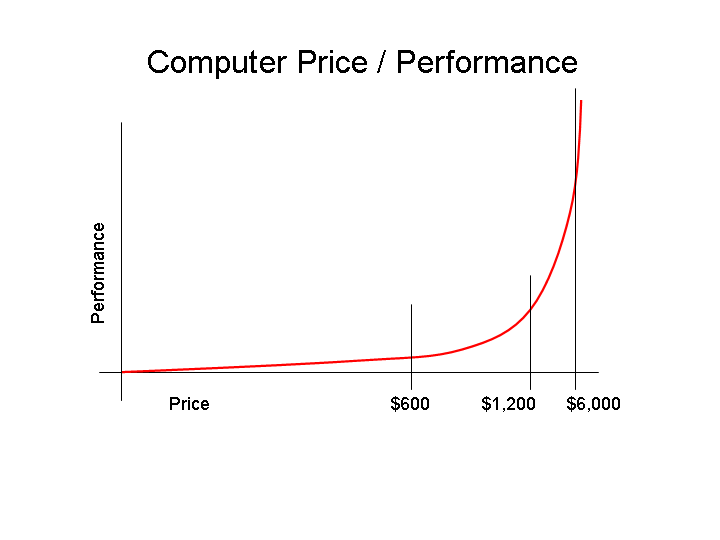
- Having a computer greatly aids your work.
- Computer performance doubles every 18 months (Moore's Law)
- Newer software will not run reliably on older systems.
Click for full-size Image
On the Bench
One of the things I do up here is run a computer repair business. Generally lots of fun but today is not a good example. I have a client with an old MAC computer -- not just any MAC but one of the licensed clones made by Power Computing. The top of the line PowerTower Pro. He came into a bit of $$$ back in 1990's and splurged on the best system available at that time. He brought it in with a dead power supply. I was able to find a new working exact replacement from these guys (story is here). Had some time today so started working on his system (he is on fixed income and specifically told me that it was OK to back-burner his machine -- it had been dead for a while). Tested the new supply -- worked fine, voltages on spec. Tested the old supply -- dead as a dodo. Put the new supply in, plugged it into the motherboard and pulled all of the PCI plugin cards -- it powered up for a second and then shut down. This means that the power supply is trying to provide the proper voltages but that the motherboard is not sending an OK signal back to the supply. Not a good thing. I started poking around and finally tested the CMOS battery (a 3-volt lithium cell). Zero volts. Hmmm... Pulled it to test it out of circuit and noticed something that gave me a sinking feeling in the pit of my stomach:

Hashima Island
I am a big fan of Urban Archeology -- looking at the history of abandoned and older buildings. I just found out about an amazing place, Hashima Island off the coast of Nagasaki, Japan. From Brian Burke-Gaffney:Hashima: The Ghost IslandHashima Island is also known as Gunkanjima. (Hashima is its formal name.) Here is an amazing collection of photographs of Gunkanjima (Hashima Island). Here are six of them -- I reduced the image size, visit Yuji's site for all of the full-size images.
Seen from a distance, Hashima Island might be mistaken for the Japanese counterpart of Alcatraz rising from the ocean like a ragged slab of concrete, or perhaps a gambling resort with deserted hotels. Few casual observers would ever guess that, only 40 years ago, this tiny island was the site of a thriving community with the highest population density on earth.
One among 505 uninhabited islands in Nagasaki Prefecture, Hashima lies in the East China Sea some 15 kilometers from Nagasaki, its naked crags striking a stark contrast with the verdant peaks of nearby islands. A closer look reveals clusters of unpopulated high-rise buildings pressing up against a man-made sea wall, a battered shrine at the top of a steep rock cliff, and not a single tree in sight.
The clue to the island's mystery lies in coal mining. Reached by long descending tunnels, coal beds below the bottom of the ocean near Hashima disgorged huge quantities of high-grade coal for almost a century. But in 1974 the inhabitants abandoned the island to the wind and salt spray, leaving behind only unneeded belongings and a few stray cats that could not be captured.


A comment to this blog -- weather wise
A reader named Mike posted the following comment to this post: Barbra Streisand -- Climatologist:Streisand (and scientists worldwide) mean that climate is getting more extreme (and extreme climate is getting more extreme) and more frequent.OK - paragraph by paragraph...
We have never had, in human recorded history, this many tropical storms in one season, this many tropical storms turn into hurricanes in one season, and this many category 3+ hurricanes in one season. We ran out of names and moved to the Greek naming system.
With your attitude and with your level of knowledge, let's hope that you live in a coastal region.
"Streisand (and scientists worldwide) mean that climate is getting more extreme (and extreme climate is getting more extreme) and more frequent."Streisand (and scientists worldwide) -- 'scuse me but Barbra Streisand is a popular entertainer, not a scientist. Perhaps you meant to say "S. as well as scientists". Minor nit aside, some agenda-driven scientists are saying that the climate is getting more extreme but if you scratch the surface and do a little research, you will find that these "scientists" are being very careful as to what data they look at and which computer models they employ for their projections. Storm data for the North Atlantic is available from 1492 to present. Sea Captains have always kept logbooks recording the minutiae of sea-going life as well as major events. Here is a graph of Atlantic Tropical Cyclones dating from 1490 through 1994 from the National Hurricane Center:

Click for full-size Image
"We have never had, in human recorded history, this many tropical storms in one season, this many tropical storms turn into hurricanes in one season, and this many category 3+ hurricanes in one season. We ran out of names and moved to the Greek naming system."You know what? You are right. The 2005 season was a doozy and it shattered the records. But, let us look at the big picture: From the National Climatic Data Center analysis of the 2005 season:
Season SummaryBut -- to continue:
There were a record 27 named storms, of which 14 were hurricanes, exceeding the 1969 record of 12 hurricanes, and 7 were major hurricanes. Of the 7 major hurricanes, an unprecendented 3 reached category 5 status, with a 4th reaching the greatest possible windspeed within category 4 of the Saffir-Simpson scale. The season has been remarkable for its early beginning and number of storms as well as the intensity of the hurricanes, including the most intense hurricane on record for the Atlantic. Many records were broken during the season and a list of the most notable are available at the end of this summary.
Since reliable records began around the middle of the 20th century (1944) with routine reconnaisance aircraft missions, no season has exceeded 19 named storms until 2005. However, it is known that at least one other season exceeded 20 named storms before 1944 and that was 1933 (21). Prior to the launch of satellites in the 1970s, and particularly before the routine reconnaissance aircraft missions, it was difficult to detect storms that did not affect land or ships, and it is therefore likely that activity in some seasons before the middle of the 20th century is underestimated.And one more paragraph:
Instead of examining only the number of tropical storms and hurricanes as an indicator of activity, NOAA's Accumulated Cyclone Energy Index takes into account the cumulative strength and duration of each storm. As shown in the figure to the right, 2005 is the third most active season on record behind 1950 and 1995 in terms of the ACE index. Tropical cyclone activity in the Atlantic basin has been above normal since 1995. This has been largely in response to the active phase of the multi-decadal signal. The average number of named storms since 1995 has been 13, compared to 8.6 during the preceding 25 years during which time the multi-decadal signal was in an inactive phase. An average of 7.7 hurricanes and 3.6 major hurricanes since 1995 compares to 5 hurricanes and 1.5 major hurricanes from 1970-1994.Follow the links and read the rest of this analysis. The overall storm energy was about the same but the number of major storms was greater. If what we were seeing was a result of Global Warming, the overall storm energy would be greater. And to make sure that we are on the same page, I firmly believe that we are entering a Global Warming period. If you look at the historical record, we have had them every couple hundred years or so. In the 900's, settlers in Greenland were harvesting wine grapes. Wine grapes require a lot more heat than eating grapes (the heat promotes the production of the sugar needed for fermentation). In the 1500's Europe was frozen in the Little Ice Age. Brueghel painted this image of the canals frozen over:

"With your attitude and with your level of knowledge, let's hope that you live in a coastal region."Mike -- you possess not only a small mind but also a small heart. I would never wish this on anyone in the spirit that you are wishing it to me. My wish for you is that you experience some growth: personal, emotional and scientific. As for me, I like where we live -- in the foothills of an active volcano.
February 25, 2006
A close look at BioFuels
Great article at St. Paul Pioneer Press/Twin Cities:Biofuels are no cure-all for energy needsWhat he said. People want to jump on bandwagons without exploring all of the consequences. Our current crop of agenda-driven scientists have a lot of responsibility for this, issuing fatuous "press releases" that seem to cure but that do not work in the real world. You need to look at the big picture.
When discussing economic policies it is important to not let rhetoric overpower reality. That happened in a recent, much-reprinted New York Times article that argued "endless fields of corn in the Midwest can be distilled into endless gallons of ethanol … that could end any worldwide oil shortage … and free the United States from dependence on foreign energy."
The story went on to discuss how much energy goes into producing ethanol. But it failed to substantiate its lead assertion of "endless gallons of ethanol" that might "free the United States" from oil imports.
The United States is an agricultural powerhouse, but even common crops like corn are not endless. In 2004, we harvested just under 12 billion bushels of corn, the most in several years. One bushel of corn yields about 2.7 gallons of ethanol. So if we processed all the corn we produce, we would have 32 billion gallons of fuel alcohol.
That sounds like a lot, but we also have a large country with many vehicles. We burn approximately 14 million barrels per day of petroleum-based "motor fuels." That is about 588 million gallons per day or 215 billion gallons per year. It sounds like a lot in absolute terms, but with a population nearing 300 million, it averages less than two gallons per person per day.
Processing all corn grown in the U.S. into alcohol would cover about 55 days worth of driving. That is a significant amount, but it is far from a level that "could end any worldwide oil shortage."
Yes, corn acreage could be expanded. Yes, other crops such as barley and wheat can also be used to produce ethanol. Yes, crop yields will continue to increase with improved technology. And yes, nongrain crops such as pasture or range grasses could go into ethanol production.
The point is, however, that even with massive increases in alcohol production and substantial increases in vehicle mileage, it is not likely that biofuels will replace fossil fuels for decades, if ever.
While biofuels are less environmentally harmful than petroleum fuels, they are not benign. Even at current acreages, corn production consumes fuel and fertilizer and entails soil erosion. Extending fuel crop production onto marginal land would exacerbate these problems.
As petroleum becomes scarcer and we seek effective ways to limit pollution, biofuels are likely to play an increasingly important role in our economy. If we implement prudent policies, increases in biofuel use can be economically efficient and make our society better off. Such policies would include incentives to reduce energy use and to develop energy saving technology. They would not mandate arbitrary levels of any specific technology including ethanol or diesel fuel derived from soy or other vegetable oils.
But we should not get carried away with our own rhetoric. Grain-derived fuel alcohol is not a panacea for all energy and environmental problems. Deluding ourselves into thinking that it is will lead us to policies that will harm our society rather than help it.
The PC Guide
Very good reference when working on older systems: The PC Guide The PC Guide has been around since 1997 and it was last updated May 2005 so it is relatively current. Good stuff! There is an active forum section as well as a bunch of useful links.Orphan Works
This seems to be the season for odious bits of legislation. First NAIS (see my posts two posts and also visit NoNAIS) Now Congress wants to seriously gut the Federal Copyright Laws when it comes to photography. From the American Society of Media Photographers website:Urgent Call for Your Action on Orphan WorksAnd it gets worse. If you take photos, design websites or create art, this is of concern to you and you should send a letter to the people involved. The website provides a list of the people involved with their FAX numbers.
The U.S. Copyright Office issued its report on Orphan Works only a couple of weeks ago. The end of that report contained proposed language for an amendment to the Copyright Act. That proposal is now being fast-tracked in Washington with a good chance of passage before the end of this Session. In my opinion, if that language is enacted in its current form, it will be the worst thing that has happened to independent photographers and other independent visual artists since Work Made for Hire contracts.
Orphan works are basically works whose copyright owners cannot be located. The term "Orphan Works" is really a dangerously misleading phrase. It makes it sound as if it includes only a few works that are not valued enough by their creators to warrant taking care of them. That may be true for owners of many kinds of copyrights. However, the reality is that for independent photographers and illustrators, the majority of your published photographs may well become Orphan Works. The reason for that is that, unlike just about every other category of copyrighted works, photographs and illustrations are typically published without any copyright notice or credit to the photographer or illustrator. The one exception to that has traditionally been editorial uses, but even there the trend seems to be away from providing credit lines. As more and more photographs are published on the Internet, credits become even rarer. Worse, even if you registered your photographs at the Copyright Office, there is no mechanism for identifying you or your photograph or for locating you through those records, if the user does not know your name.
Under the proposed legislation, a person or other entity who wants to use a copyrighted work is required to make only a "good faith, reasonably diligent search" to locate the copyright owner. If, after making such a search, the user is unable to locate the copyright owner, he/she/it gets an almost free license to use the work. If the copyright owner never comes forward, the user gets to use the work for free. Even if the copyright owner discovers the use and demands payment, the MOST the copyright owner can get is "reasonable compensation," i.e. a reasonable license fee for the use actually made. There is NO possibility of statutory damages or attorneys' fees, even if the work was registered before the use was made without your permission.
Any port in a storm
With all the cry over the Arabs buying control of six US ports, it's worth checking a few facts. From UPI:UAE terminal takeover extends to 21 portsThis buy-out has been in the works since last November. From this Treasury Department Press Release:
A United Arab Emirates government-owned company is poised to take over port terminal operations in 21 American ports, far more than the six widely reported.
The Bush administration has approved the takeover of British-owned Peninsular & Oriental Steam Navigation Co. to DP World, a deal set to go forward March 2 unless Congress intervenes.
P&O is the parent company of P&O Ports North America, which leases terminals for the import and export and loading and unloading and security of cargo in 21 ports, 11 on the East Coast, ranging from Portland, Maine to Miami, Florida, and 10 on the Gulf Coast, from Gulfport, Miss., to Corpus Christi, Texas, according to the company's Web site.
CFIUS and the Protection of the National Security in the Dubai Ports World Bid for Port OperationsAnd finally, foreign management of US ports is nothing new. From The SF Gate:
All members of the Committee on Foreign Investment in the United States (CFIUS) understand that their top priority is to protect our national security, including homeland security.
On November 29 of last year, two companies publicly announced a proposed transaction: Dubai Ports World (DPW), a state-owned company located in the United Arab Emirates, proposed to acquire The Peninsular and Oriental Steam Navigation Company (P&O), a British firm that operates in a number of U.S. ports and other ports around the world. The acquisition would include terminal port operations at a number of U.S. ports – not the ports themselves. The Department of Homeland Security (DHS), particularly the Coast Guard and U.S. Customs and Border Protection, is in charge of port security.
DPW and P&O believed that this proposed transaction could raise national security issues that should appropriately be reviewed by the U.S. Government. The companies contacted CFIUS on October 17 and voluntarily told the Committee of their intention to file a notification with CFIUS for a national security review. They also held a complete briefing for DHS and other CFIUS members with security, defense, or law enforcement responsibilities on October 31.
Each of the CFIUS 12 members (departments and agencies) conducts its own internal analysis. In this case, the Departments of Transportation and Energy were also brought in to the CFIUS review to widen the scope and to add the expertise of those agencies reviewing the transaction.
On November 2, well before DP World and P&O filed with Treasury, CFIUS requested an intelligence assessment of the foreign acquirer. A little more than 30 days later -- still well before the companies formally filed with CFIUS or the review began -- the intelligence community provided CFIUS with a threat assessment regarding whether the foreign acquirer -- DPW – has the intention or capability to threaten U.S. national security.
Foreign involvement is nothing newAnd:
Reports that the government of Dubai is on the verge of taking over six U.S. seaports have been greatly exaggerated.
Even so, Congress is right in demanding more details about a deal that would put a company backed by the government of Dubai, one of seven emirates that make up the United Arab Emirates, in charge of some operations at major U.S. ports.
Most terminal operators at U.S. ports are foreign companies and some are owned in part by foreign governments.
APL, which manages terminals in Oakland, Los Angeles, Seattle and Alaska, is owned by the NOL Group, which is majority owned by the Singapore government.
The Chinese government owns part of a company that operates a terminal at the Port of Long Beach.
That company, Cosco Container Lines, a division of China Cosco, caused a stir similar to the current one back in 1998.
Cosco ships had been calling on the Port of Long Beach for many years, using a public terminal. In the late 1990s, it wanted to build its own terminal at the former Long Beach Naval Station, says Howard Finkel, a senior vice president with Cosco.
The deal raised national-security concerns and Congress passed a bill that effectively scuttled it.
A few years later, other tenants at the port vacated space and Cosco was able to build its own terminal, says Art Wong, public information office for the Port of Long Beach.
R.I.P. Don Knotts
Actor Don Knotts passed away -- Yahoo/AP has an obituary:Don Knotts, TV's Lovable Nerd, Dies at 81And a bit more (talking about the Andy Griffith show):
Don Knotts, the skinny, lovable nerd who kept generations of television audiences laughing as bumbling Deputy Barney Fife on "The Andy Griffith Show," has died. He was 81.
Knotts died Friday night of pulmonary and respiratory complications at Cedars-Sinai Medical Center in Beverly Hills, said Paul Ward, a spokesman for the cable network TV Land, which airs "The Andy Griffith Show," and another Knotts hit, "Three's Company."
The show ran from 1960-68, and was in the top 10 of the Nielsen ratings each season, including a No. 1 ranking its final year. It is one of only three series in TV history to bow out at the top: The others are "I Love Lucy" and "Seinfeld." The 249 episodes have appeared frequently in reruns and have spawned a large, active network of fan clubs.An American Icon.
As the bug-eyed deputy to Griffith, Knotts carried in his shirt pocket the one bullet he was allowed after shooting himself in the foot. The constant fumbling, a recurring sight gag, was typical of his self-deprecating humor.
Knotts, whose shy, soft-spoken manner was unlike his high-strung characters, once said he was most proud of the Fife character and doesn't mind being remembered that way.
Quantum Computing
My brain hurts... From the University of Illinois at Urbana-Champaign:Quantum computer solves problem, without runningQuantum is one of those bizarre area where if you think that you understand it, you are either insane or you do not fully understand what is being asked. Quantum computing is now in its infancy but this will be the future of computing in 20 years or so.
By combining quantum computation and quantum interrogation, scientists at the University of Illinois at Urbana-Champaign have found an exotic way of determining an answer to an algorithm – without ever running the algorithm.
Using an optical-based quantum computer, a research team led by physicist Paul Kwiat has presented the first demonstration of "counterfactual computation," inferring information about an answer, even though the computer did not run. The researchers report their work in the Feb. 23 issue of the journal Nature.
Quantum computers have the potential for solving certain types of problems much faster than classical computers. Speed and efficiency are gained because quantum bits can be placed in superpositions of one and zero, as opposed to classical bits, which are either one or zero. Moreover, the logic behind the coherent nature of quantum information processing often deviates from intuitive reasoning, leading to some surprising effects.
"It seems absolutely bizarre that counterfactual computation – using information that is counter to what must have actually happened – could find an answer without running the entire quantum computer," said Kwiat, a John Bardeen Professor of Electrical and Computer Engineering and Physics at Illinois. "But the nature of quantum interrogation makes this amazing feat possible."
Sometimes called interaction-free measurement, quantum interrogation is a technique that makes use of wave-particle duality (in this case, of photons) to search a region of space without actually entering that region of space.
Utilizing two coupled optical interferometers, nested within a third, Kwiat’s team succeeded in counterfactually searching a four-element database using Grover’s quantum search algorithm.
"By placing our photon in a quantum superposition of running and not running the search algorithm, we obtained information about the answer even when the photon did not run the search algorithm," said graduate student Onur Hosten, lead author of the Nature paper. "We also showed theoretically how to obtain the answer without ever running the algorithm, by using a ‘chained Zeno’ effect."
February 24, 2006
Light posting again today
Jen and I set the alarm for 5:00am and got up and drove the 200 miles from our farm down to Olympia, Washington (our State Capital) to meet with Representative Kelli Linville regarding the NAIS legislation I mentioned in yesterday's post. We met up with a bunch of other like-minded people, some of whom came in from Eastern WA (a much longer drive) and we set up a table on the Capitol steps from 11:00am to 1:00pm and proceeded to talk with anyone who was interested in what we had to say.
Some people blew us off but if we got someone to come over to see what we were about, we were generally able to get them very interested. There is a large movement in this area for Organic Farming and "Slow Food" and legislation of this sort will make it that much harder for us to provide these to our customers. Plus, the Federal law as written affects anyone with large animals -- horse, llama and alpacca owners included.
At 1:00pm, we met with Representative Linville who reassured us that the WA State legislation is directed only towards Dairy and Beef cattle and there is a built-in cutoff for smaller herds (either 30 or 50 animals -- forget which) where the registration becomes strictly voluntary.
She was happy to meet with us and she then had her aide put us in touch with the assistant to our Federal Congressman who handles Agricultural matters. This made the entire trip worthwhile as getting a foot in the door on the Federal level can sometime take a lot of effort and we had one handed to us on a plate (actually, a page from a green memo pad and a few phone calls but same diff...).
The one thing that was really interesting is that during the two hours we were on the Capitol steps, there were a number of school groups touring the campus. Ages ranged from pre-teen to late High-School. Some of the students were interested, some of the teachers expressed interest but for each group, there was a "minder" that insisted that they have no contact with us and that shepherded them away from our area.
We were well dressed, not rowdy, mostly middle-aged and some with kids. We had a few picket signs but we were holding them quietly. No giant paper mache puppets. No singing Kum-by-ah.
So correct me if I am wrong but these school kids are being brought to the State Capitol to see how WA State is governed and how the legislative process works, but they are being told that contact with one of the more fundamental parts of lawmaking "Ist Verboten!"
I will own up to calling out "Freedom of Speech" and Censorship" and the main URL of NoNAIS.ORG a few times to their backs. So flog me.
February 23, 2006
NAIS - your government at work
Jen and I have been following this legislative train-wreck with an increasing sense of dread and frustration. The item is NAIS -- the National Animal Identification System This is supposed to protect us against terrorism and ensure a safe supply of food. In reality, it is a one-size-fits-all piece of legislation that mirrors what the large commercial producers are already doing but also makes it mandatory for the small farmer to follow the same procedures whether these make sense at that scale or not. All premises have to be registered. Your premises can be registered without your knowledge, simply buying a sack of chicken feed will cause an entry in the national database. If you have a vet visit your farm, the veterinarian is obligated to register your premises. Invasion of privacy anyone? Every animal is chipped at the expense of the owner (So you spend $10-$30 to chip a chicken that costs you $1.00 and you plan to eat yourselves...) You need to file a report whenever an animal is born, bought, sold, killed and this is interesting: moved. If you take a doe to a stud to get some nookie, that transaction has to be reported. When you talk with the people promoting this, they are quick to assure you that there will be a different set of rules for small holders whose animals do not enter 'mainstream' food production......BUT...
NoNAIS.orgOne of the other issues is that the States (not wanting to feel left out) are starting to look at legislation of their own. Please, for the sake of the Small American Farmer, spend 30 minutes of your time looking into this and sending an email to your congress-critters. The NoNAIS website has a collection of links under their CONTACTS listing. Tell some friends. American farmers, large and small, only account for about 2% of the USA population but we are the ones who feed everyone. We do not ask for help often but we are now and we can really use it... Thanks!
Stop Animal ID.org
February 22, 2006
The Greenland Glaciers
The glaciers are shrinking! The glaciers are shrinking! It seems that the people who reported this didn't give up all of the data. From the Technology Commerce Society website:Ice StormPeople like this give Science (the study, not the paper) a bad name...
The latest issue of Science contains a paper by Eric Rignot and Pannir Kanagaratnam claiming that glaciers along the periphery of Greenland are melting at a rapidly increasing rate. Another paper on this subject was published by Science just last year. Ola Johannessen did not consider direct ice lost by glaciers into the ocean but instead only focused on elevations changes. Johannssen showed that increasing snowfall in Greenland was leading to greater ice accumulations than had previously been measured and this was acting to slow Greenland's contribution to sea level rise. It was conspicuously ignored in this new report.
Light posting tonight
Was at the preview for this auction. I took a bunch of pictures and will post them this weekend -- the scope of the place is amazing. Big big industrial place - fascinating sort of urban archeology. One item I'm going to be bidding on. (crossing fingers!)February 21, 2006
New levels of pain...
Let me tell you, Milk snorting from one's nose can be painful. Beer is even worse. These guys should offer a warning before you visit their website! Once again, Cox and Forkum absolutely NAIL IT!
Click for full-size Image
DOH!
As you know, I have been having problems with the cache at our satellite provider. This manifests as having older pages being displayed in the browser. Hitting the refresh button [F5] has no effect. Found out that hitting [CTRL]+[F5] forces a reload from the source URL. Works like a charm!A nice turn of phrase
Someone on a machining forum was talking about an older system and they said that it was: "state of the ark" Cute!Jean-Luc Picard -- Starfleet Captain and Blogger
Good stuff: A Diary of a Harassed Starfleet Officer in the 24th Century on the Star Trek of LifeFebruary 20, 2006
An amazing Rock and Roll treasure
I ran into this news story at CBS:A Memorabilia Collection That RocksTurns out that Bill was quite the pack-rat -- it's not just the photographs and posters, there are also thousands of concert tapes, videos, millions of photographs, etc:
It sounds more like something from the old West than modern day San Francisco. It was dusty. It was musty. It didn't smell real good.
This is a true story about buried treasure. Deep in the basement of a non-descript warehouse, down a maze of back alleys, Bill Sagan discovered what amounts to a goldmine.
"It was 25 feet high in height, below ground. Part of it was below ground," said Sagan. "And there were, I thought, hundreds of thousands of items that were in there. And truly there were millions of items."
It was a rock-and-roll treasure trove--millions of original photographs, posters, documents and much more of forgotten artifacts from an unforgettable musical era.
"We've been told that there exists no other trove of rock-and-roll history that is anywhere near the size of this anywhere else," said Sagan.
To explain where this lost treasure came from we have to travel back more than 40 years to a time when San Francisco was at the vanguard of the rock-and-roll revolution. And leading the charge was one man, Bill Graham.
First there are the photographs. "I thought there was maybe a half million to a million slides and negatives," said Sagan. "As it turned out, there's probably is closer to a million and a half to two million slides and negatives."Sagan (the guy who bought the collection) is keeping the really rare stuff together as a collection and is just selling off lesser items and duplicates to fund the collection. The website for this is here: Wolfgang's Vault (Bill Graham's given name was Wolfgang Grajonca) They also have a streaming radio of various concert performances. Paul Allen must be fuming. [grin]
There are posters by the thousands, the psychedelic artwork that went up weekly in San Francisco in the 60's. "We have more than 500 posters that are so rare that their retail price would be in excess of $15,000," Sagan estimated. "There were drawers full of tickets from decades of concerts."
Graham seems to have kept every contract he ever signed. But he had one more big surprise in store, and only after he bought the collection and started going through boxes did Sagan discover what may be the most valuable asset.
"There are nearly 7,000 tapes of 7,000 different performances,' said Sagan. "And the reason I say nearly is because we haven't counted them all and we haven't looked at them all."
Graham didn't just save memorabilia from the concerts, he saved the concerts themselves--rare, high quality recordings of legendary concerts that haven't been seen or heard, in some cases, for 40 years.
Just to give you an idea of what Sagan discovered: The Who's last performance of their rock opera, "Tommy," before drummer Keith Moon died at age 26, and the last concert ever from the British punk-rock pioneers The Sex Pistols.
Bill Graham's cameras had captured most of all the big names through three decades of rock. The Allman Brothers, Chicago, Lenard Skynard, Peter Frampton, Bob Marley.
A tale of two houses
From A Crafty Madness comes this tale of two houses:Mock the CasbahGood stuff!
It occurs to me that residents of the House of War and residents of the House ofNutsIslam have some very different reactions to some very similar situations. Observe:
February 19, 2006
Good on them!
From Bloomberg:Israel Approves Sanctions on Hamas-Led PalestiniansEmphasis mine. That is the reason for Israel's action. This is not an act to get rid of Hamas, this is an act to get them to wake up and smell the cappuccino. Israel is not going away and if they want to get the money to play "nation" with, they will need to act like a responsible nation. I feel sorry for them in a sense, they have to climb out from under Arafat's legacy of corruption and terrorism support. If they can manage this, Israel will bend over backwards to help them. If not, say buh-bye!
Acting Israeli Prime Minister Ehud Olmert's cabinet approved sanctions against the Palestinian Authority today as the militant Hamas group nominated Ismael Hania for prime minister.
The punitive actions include freezing the monthly transfer of about $50 million in tax and customs fees that Israel collects on behalf of the Palestinian Authority and reducing the number of Palestinians allowed to work in Israel, a government statement said. The measures take effect when the new Hamas-led Palestinian cabinet is set up, which could take as long as five weeks.
"It is clear that with a majority for Hamas in the legislature and with the formation of a government under the leadership of Hamas, the Palestinian Authority will become a de facto terrorist authority and Israel cannot accept this," Olmert said, according to the statement.
The Palestinian Legislative Council yesterday held its first meeting since the election and agreed that Hamas will start negotiations to form a government. Palestinian Authority President Mahmoud Abbas, who belongs to the rival Fatah party, called on Hamas to disarm militants and abide by peace agreements with Israel, a request Hamas members rejected.
Bonth, Jameffff Bonth...
Ouch! From The Sunday Mirror:EXCLUSIVE: THE NAME'S BOND.. BROKE BONDStunts can go wrong, sometimes spectacularly...
New James Bond Daniel Craig has already failed to make the grade as a tough guy - after a villain knocked out two of his teeth in his FIRST fight scene.
Craig, 37, was in Prague filming the remake of Casino Royale when the stunt went wrong.
As the shaken star staggered backwards clutching his bleeding mouth, cameramen thought it was a brilliant piece of acting.
But they quickly realised the new 007 was really hurt. His injuries were so bad local dentistry experts could not treat him. So Craig's dentist was flown out from London for emergency surgery in the Czech capital Prague.
Dentist Rod McNeil, based in London's Cavendish Square, fixed caps to his broken teeth then flew back to Britain.
The actor has now been given six gumshields and told to wear them while filming stunt scenes for the £60million movie at Prague's Barrandov Studios.
Global warming anyone?
Brrrr... Much colder than normal for this time. Check out this map
Click for full-size Image
Just wonderful...
From the News Telegraph:Iranian fatwa approves use of nuclear weaponsWords fail...
Iran's hardline spiritual leaders have issued an unprecedented new fatwa, or holy order, sanctioning the use of atomic weapons against its enemies.
In yet another sign of Teheran's stiffening resolve on the nuclear issue, influential Muslim clerics have for the first time questioned the theocracy's traditional stance that Sharia law forbade the use of nuclear weapons.
One senior mullah has now said it is "only natural" to have nuclear bombs as a "countermeasure" against other nuclear powers, thought to be a reference to America and Israel.
The pronouncement is particularly worrying because it has come from Mohsen Gharavian, a disciple of the ultra-conservative Ayatollah Mohammad Taghi Mesbah-Yazdi, who is widely regarded as the cleric closest to Iran's new president, Mahmoud Ahmadinejad.
Nicknamed "Professor Crocodile" because of his harsh conservatism, Ayatollah Mesbah Yazdi's group opposes virtually any kind of rapprochement with the West and is believed to have influenced President Ahmadinejad's refusal to negotiate over Iran's nuclear programme.
The comments, which are the first public statement by the Yazdi clerical cabal on the nuclear issue, will be seen as an attempt by the country's religious hardliners to begin preparing a theological justification for the ownership - and if necessary the use - of atomic bombs.
Light posting today
Been busy with farm stuff the last couple days (the rain finally stopped!) plus going through a bunch of transformers getting them ready for sale (not just the neons!) I'll post a bit after dinner and the usual spew will resume tomorrow. Besides, I have a nice juicy troll to eviscerate!!!February 18, 2006
Dutch Cartoon (animated with sound)
Gerard at American Digest points us to this animated cartoon that really sums up the Jihadisti reaction to their precccioussssesses Mohamed cartoons.February 17, 2006
Cute candy idea
From Firebox.com:Roulette ChocolateOnly available in the EU for now... Cute idea!
Willy Wonka meets the Deer Hunter!
Eating chocolate is not something most of us usually associate with raw, buttock-clenching tension. A quick straw poll around Firebox HQ showed that the closest any of us has ever come to this pleasure-meets-pain-style sensation was when we shared a tube of Smarties whilst watching the final episode of 24.
The thing is, chomping on choccy has always been a relatively humdrum experience... Until now.
Because by combining one of life's great pleasures (chocolate) with one of death's best buddies (Russian Roulette), clever confectioners have come up with this fiendishly amusing gift box.
Seated in individual compartments, twelve chocolate bullets lay waiting to be bitten into. Although eleven of the sweet little slugs contain delicious praline centres, one conceals a seriously red hot chilli that's guaranteed to blow your head off - metaphorically, at least.

A well-reasoned headline
From the Australian Sydney Morning Herald:Israel puts the squeeze on fledgling democracyCouple of things -- first, go and read the Hamas Charter. Here are four excerpts:
By Ed O'Loughlin Herald Correspondent in Ramallah
Hamas prepares to take charge of the Palestinian parliament today, with Israel warning that the move will spark a diplomatic and economic blockade.
Newly elected MPs from Hamas - which had previously boycotted the Palestinian Authority and its institutions - were expected to nominate the Gaza leader Ismail Haniyeh as their candidate for prime minister.
"Israel will exist and will continue to exist until Islam will obliterate it, just as it obliterated others before it."The Protocols of the Elders... has of course been thoroughly debunked as a virulent anti-Semetic hoax. Finally, running the author's name through Google reveals a very strong anti-Israel bias.
"The Islamic Resistance Movement believes that the land of Palestine is an Islamic Waqf consecrated for future Moslem generations until Judgement Day. It, or any part of it, should not be squandered: it, or any part of it, should not be given up."
"There is no solution for the Palestinian question except through Jihad. Initiatives, proposals and international conferences are all a waste of time and vain endeavors."
"After Palestine, the Zionists aspire to expand from the Nile to the Euphrates. When they will have digested the region they overtook, they will aspire to further expansion, and so on. Their plan is embodied in the "Protocols of the Elders of Zion", and their present conduct is the best proof of what we are saying."
In serious need of a clue
From The United Nations Conference on Disarmament webpage:CONFERENCE ON DISARMAMENT HOLDS THOUSANDTH MEETINGEmphasis mine -- the successes of the past? You would think that after meeting one thousand times and accomplishing exactly zero, it might be time to think about disbanding and moving the resources to something more productive.
The Conference on Disarmament, the world’s sole multilateral forum for disarmament negotiations, this morning held its thousandth meeting, an anniversary that was highlighted by all the speakers who urged further cooperation, compromise and change in order to break the deadlock and return the Conference to the successes of the past.
Addressing the Conference, Sergei Ordzhonikidze, the Director-General of the United Nations Office at Geneva and Secretary-General of the Conference, said without political decisions at the highest levels, even the most determined efforts of the existing multilateral disarmament bodies, including the Conference on Disarmament, would not succeed. The Conference should not be discouraged from using existing and potential mechanisms available to it now, such as debates on issues on the agenda, for mutually influencing policies and security perceptions of Member States and for furthering the consensus building process. In parallel, the Conference should review its working methods and seek new approaches that could make it more responsive to contemporary security threats and challenges.
Cool new vaccine technology
The people at Protein Sciences Corporation recently announced a new way to make Flu vaccines. From this article at Forbes:New Strategy Speeds Flu Vaccine ProductionVery interesting -- they have a product: FluBlØk™ in PhaseII/III testing and is expected to come to market in 2007. Useful for a lot of other strains too if they can find a good virus carrier. Flu is the one to work on for now though.
Researchers say they've developed a commercially viable process that could enable the mass production of flu vaccines within weeks, instead of the months it now takes.
This approach uses a purified protein from the surface of a virus called hemagglutinin (the "H" in a virus' designation -- for example -- the H5N1 bird flu virus) to trigger an immune response to a specific strain of virus.
The genes responsible for production of hemagglutinin are inserted into a pathogen called a baculovirus, which are then used to infect specific host cells. Those infected cells produce recombinant hemagglutinin (rHA).
Phase II clinical trials show that the vaccines produced using this method are safe and trigger an immune response equal to or greater than conventional chicken egg-based vaccines.
The researchers say they've successfully produced rHA from four strains of influenza that may trigger a pandemic -- H5, H7, H9 and H2 -- at levels where the cost of vaccine manufacturing would be equal to, or less than, that of traditional egg-based vaccines.
February 16, 2006
Aww Crap!
Word is coming in about a large landslide in the Philippines From the Canadian Globe and Mail/AP:200 feared dead, 1,500 missing in Philippine landslidePlacing these people in our prayers this evening. More as I find out...
A landslide rumbled down a mountainside on an eastern Philippine island Friday, burying hundreds of houses and a school packed with elementary students. Red Cross officials estimated at least 200 dead and 1,500 missing.
“It sounded like the mountain exploded, and the whole thing crumbled,” survivor Dario Libatan told Manila radio DZMM. “I could not see any house standing any more.”
Senator Richard Gordon, head of the Philippine Red Cross, said an entire village appeared to have been buried, with perhaps 200 dead and 1,500 missing. The landslide on Leyte island followed two weeks of non-stop rains.
“There is no body count yet, it's our estimate,” he told the Associated Press by telephone from Geneva. “We're mobilizing rescue operations. This areas is infamous for landslides.”
Whoops!
Not a good year or so for Mormons. From the LA Times:Bedrock of a Faith Is JoltedEmphasis mine. The "purer" you set yourselves to be, the harder the eventual fall. Read "Under the Banner of Heaven" for a fascinating examination of this faith.
DNA tests contradict Mormon scripture. The church says the studies are being twisted to attack its beliefs.
From the time he was a child in Peru, the Mormon Church instilled in Jose A. Loayza the conviction that he and millions of other Native Americans were descended from a lost tribe of Israel that reached the New World more than 2,000 years ago.
"We were taught all the blessings of that Hebrew lineage belonged to us and that we were special people," said Loayza, now a Salt Lake City attorney. "It not only made me feel special, but it gave me a sense of transcendental identity, an identity with God."
A few years ago, Loayza said, his faith was shaken and his identity stripped away by DNA evidence showing that the ancestors of American natives came from Asia, not the Middle East.
"I've gone through stages," he said. "Absolutely denial. Utter amazement and surprise. Anger and bitterness."
For Mormons, the lack of discernible Hebrew blood in Native Americans is no minor collision between faith and science. It burrows into the historical foundations of the Book of Mormon, a 175-year-old transcription that the church regards as literal and without error.
Great Honda Advertisement
From Honda UK Video, crank the sound up a notch. Cute...Mini Ice Age
This is a few weeks old but I just remembered it -- had not blogged about it before. From United Press International:Scientist predicts 'mini Ice Age'And before the Little Ice Age, it was warm enough in Greenland to grow wine grapes. Grapes being grown for wine generally need a lot more heat and sunshine to 'sugar up'. At the latitudes of Greenland, sunlight is not an issue but warmth is -- archaeological digs in coastal settlements there show a pronounced wine industry. And, by the way, the Pulkovo Observatory is no slouch when it comes to Science. Founded in 1839, it is presently one of the top research centers in Russia with a specialty in Solar (and Stellar) Physics...
A Russian astronomer has predicted that Earth will experience a "mini Ice Age" in the middle of this century, caused by low solar activity.
Khabibullo Abdusamatov of the Pulkovo Astronomic Observatory in St. Petersburg said Monday that temperatures will begin falling six or seven years from now, when global warming caused by increased solar activity in the 20th century reaches its peak, RIA Novosti reported.
The coldest period will occur 15 to 20 years after a major solar output decline between 2035 and 2045, Abdusamatov said.
Dramatic changes in the earth's surface temperatures are an ordinary phenomenon, not an anomaly, he said, and result from variations in the sun's energy output and ultraviolet radiation.
The Northern Hemisphere's most recent cool-down period occurred between 1645 and 1705. The resulting period, known as the Little Ice Age, left canals in the Netherlands frozen solid and forced people in Greenland to abandon their houses to glaciers, the scientist said.
Griping about the Web
A List Apart is an excellent blog for people who do web design. This Valentines Day, they hosted their own little massacre and invited some web design notables to comment on those things that drive them nuts...Valentine's Day MassacreAnd over 20 more -- excellent ideas and thoughts on web design.
by Our Gentle Readers
Roses are red, violets are blue, sometimes dear web, we sure hate you.
Daniel Aitken, web designer, proprietor
What angers me in today’s web, is the term “Web 2.0.” It’s the “2.0” specifically—the idea that the entire web is in for an upgrade, a change for the better to version two.
The web is not a singular application, it is a fluid interface. A means of information distribution, of functionality, of user-interoperability. It does not constrain to any idea of what an application is, because it is the combination of individual applications that make it so fluid. New coding techniques are constantly created, new hacks and workarounds for non-standards-compliant browsers. New ways of putting together existing code are being thought of and put into use every day somewhere on the millions of web pages the internet is home to. We aren’t yet on web 2.0, or internet 2.0, or computing 2.0. This is a dynamic change that will continue to happen whether or not we apply version numbers. The mass of netizens has triggered the implementation of web based applications, not a developer meeting that decided on the version change.
Prickly City
Today's Prickly City was great: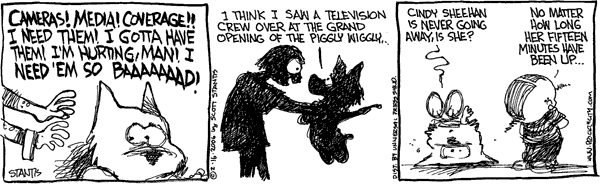
Click for full-size Image
February 15, 2006
Hillary visits a school
Swiped from Mostly Cajun who swiped it from here.Hillary visits a school…………Heh...
Hillary Clinton goes to a primary school in Ithaca, New York, to talk about the world. After her talk she offers question time.
One little boy puts up his hand, and the Senator asks him what his name is.
“Kenneth”, replied the little boy.
“And what is your question, Kenneth?”
“I have three questions:
1. Whatever happened to your medical health care plan?
2. Why would you run for President after your husband shamed the office?
3. Whatever happened to all those things you took when you left the White House?”
Just then the bell rings for recess. Hillary Clinton informs the kiddies that they will continue after recess.
When they resume Hillary says “OK, where were we? Oh, that’s right, question time. Who has a question?”
A different little boy puts his hand up. Hillary points him out & asks him what his name is.
“My name is Larry.”
“And what is your question, Larry?”
“I have 5 questions:
1. Whatever happened to your medical health care plan?
2. Why would you run for President after your husband shamed the office?
3. Whatever happened to all those things you took when you left the White House?”
4. Why did the recess bell go off 20 minutes early?
5. What happened to Kenneth?”
Cartoons, Script Kiddies and Michelle Malkin
It seems that the Cartoon Jihad has spilled over into the Internet. (A Western invention thank you!) Some high-profile bloggers have had their websites attacked by denial of service attacks hosted from foreign countries. Writer Michelle Malkin is one:THE ISLAMISTS' WAR ON THE INTERNETShe links to some reports from Internet Security people including this one from ISN Security Watch -- an excerpt:
Last Tuesday, during or immediately after my appearance on Fox News Channel to discuss the Mohammed Cartoons, this blog was hit by a large, foreign-based denial of service attack. Last night, my hosting service notified me that it is receiving ongoing threats from individuals vowing to take down this site--and others along with it--which will presumably continue until I take down the cartoons. For now, we are on guard and continuing with business as usual. But you should know there's something much wider and deeper going on:
...Since the explosive growth of the virtual jihad community after the loss of Afghanistan, which has seen the number of radical websites mushroom from less than 100 to several thousand today, the mujahideen have demonstrated their sophistication in the medium.It's a war and it's happening now. We need to wake up if we are to stay free. Michelle lists a gmail account and she posted a few samples of email she has received since writing about the Cartoons -- here is one:
Much discussion space is given not only to protecting themselves from penetration, but for taking the hacker warfare to their enemies. Most radical jihadi forums devote an entire section to the technique. For example, in the “jihadi hacker forum” of the radical jihadist al-Ghorabaa site (http://www.alghorabaa.net/forums), the most popular comment strings are: “penetrating computer devices” and “easy methods to penetrate servers in an intranet”.
Further postings feature: “How to steal passwords (deliverable via email)”; “How to reveal the passwords under the asterisks”; “How to protect yourself from attack”; “Can you be arrested due to your emails?”; “Encyclopedia of hacking sites”; “Concealment on the web: a lesson in intermediaries” (anonymous browsing techniques); and “A book in Arabic for instruction in hacking techniques”.
This last posting provides a 344-page, profusely illustrated, step-by-step guide intended by the anonymous author for “terminating pornographic sites and those intended for the Jews and their supporters”.
From: naser jianpour (n_jianpour@yahoo.com)The last line kind of gives it away -- pathological megalomania, lusting for the Caliphate that never existed and probably secretly jealous of the fact that the average Arabs education is one of the worst on this planet. Just so we understand each other a bit better, please read my post:
To: writemalkin@gmail.com
Mailed-By: yahoo.com
Date: Feb 10, 2006 12:04 PM
Subject: we will kill you
I am Iranian I am a mosleme .
We will kill you( every )
down with you( Crectian & jowe.)
world is mine.
Tales of Nasrudin -- why I like Muslims but detest Islamiststo understand my feelings towards the true practice of Islam.
Brokeback Camel
The reaction for this should be good! From NewsMax:Gay Muslim Film Could Spark ProtestsHeh. Considering that they (Islamists) punish homosexuals by stoning them to death but call it something else when it is a manifestation of power (thinking Yasser Arafat here), the cognitive disjunct from this film should be fun to see if no one gets hurt...
A new documentary exploring the lives of gay Muslims could soon set off another round of violent protests in the Middle East.
The film’s producer, Sandi Dubowski, has promised to submit his movie to all the major film festivals of the Muslim and Western worlds. And even if it is rejected, he told Variety magazine, "We’ll find ways of screening it in every Muslim nation, even if it’s underground."
The film, titled "In the Name of Allah," will give viewers a glimpse of the Muslim world from a gay, lesbian, and transgender perspective.
Dubowski said it was important for understanding Islam. "The world right now needs to understand Islam," he told Variety, "and these are the most unlikely storytellers of Islam."
Graven Images of Mohamed
The ever excellent Zombietime comments about the Danish Jyllands-Posten cartoon kerfuffle and notes that the thing that has the Islamist's knickers in a twist is that this is an image of Mohamed which is supposed to be forbidden. Funny thing though, Zombietime has a wonderful collection of Islamic depictions of Mo'boy. Here is one:The chunk of meteorite that Mo' is "blessing" is what is enshrined in the Kaaba -- the black cube building at Meca. The building that was engineered and project managed by Bechtel and the construction project that got BinLaden construction off the ground financially and politically. A more perfect ground zero I cannot think of! Zombietime has a lot of other collections of images of Mohamed -- European Medieval and Renaissance Images, Dante's Inferno, French Book Covers, Modern Satirical Cartoons and much much more (including the original Danish cartoons). This whole flap is a perfect example of how these thugs really understand our psychology and are manipulating the public image to garner sympathy. The riots are not spontaneous, people are bussed in, reporters are called, the riot happens and then everyone goes home...
Miniature of Mohamed re-dedicating the Black Stone at the Kaaba. From Jami Al-Tawarikh ("The Universal History" written by Rashid Al-Din), a manuscript in the Library of the University of Edinburgh; illustrated in Tabriz, Persia, c. 1315.

More fun...
My ISP (Starband) is still having odd behaviour with their caching. If I go to a system on another ISP, I see the pages just fine but the one's I see here do not update for me. Wierd...Loosing a bit of Chicago history
For a long time, THE restaurant in Chicago was Berghoff's. Family owned for over 107 years, the third generation Berhgoffs (he is 70, his wife is 68) decided it's time to close the doors. A bit of history from their website:THE EARLY YEARS (1887-1930)Here is Herman holding the first liquor license issued in Chicago after the repeal of Prohibition:
The restaurant's founder, Herman Joseph Berghoff, an immigrant to America in 1870 from Dortmund, Germany, began brewing Berghoff Beer in Fort Wayne, Indiana, in 1887 as a family enterprise with his three brothers, Henry, Hubert and Gustav. A promoter by nature known for his sparkling blue eyes and determination, Herman dreamed of expanding the market for his beer beyond Indiana. The Chicago World's Fair of 1893 proved to be a perfect introduction when he sold the beer to fair-goers on the now-famous Midway.
Inspired by the wide public acclaim the beer received at the fair, Herman opened the Berghoff Cafe in 1898 to showcase his celebrated Dortmunder-style beer. Originally located at the corner of State and Adams streets, one door down from its present location, the bar sold beer for a nickel and offered sandwiches for free.
"We'll give the Dutchman six months," said Herman's critics. He proved them wrong, and the bar prospered even during Prohibition (1918-1933) when it served near beer and Bergo Soda Pop. Unable to rely on beer sales alone, the bar expanded into a full-service restaurant, which earned its own strong reputation by Prohibition's end.

February 14, 2006
Great places
One of the wonderful things about discovering Bellingham is all the places tucked into the more industrial areas. Bellingham has very strong roots as a working city and its geographic position as the last major US port city on the "Marine Highway" to Alaska keeps its industrial heart vital. We have a Graingers, a Fastenal, an Applied and the Mother of All Hardware Stores: Hardware Sales (family owned since 1962) We also have this place: Re Lectronics I knew they were there but didn't have any reason to stop in until today. I have a client with an ancient Power Computing (MAC Clone) Power Tower 250 with a blown power supply. I called a few days ago and was told that their MAC person came in on Tuesday and Thursday and to try then. These were not the people who waited on me but it was damn close...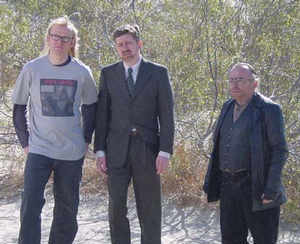
Still odd behaviour
Not me - the weblog software. I have it narrowed down to a wedged cache at the internet satellite service provider. I'll be giving them a call tomorrow. Had a wonderful valentines day dinner with Jen at a local Italian restaurant. She had a braised shank of lamb (big enough for three meals -- we brought most of it home although it was wonderful -- served with a saffron risotto). I had their Pasta Toscano -- fusilli pasta with sun dried tomatoes, spinach, sliced sausage and canalized onions. Who says you have to rough it when you live in the country. If you do not feel like Italian, there are three other world-class restaurants (and one good burger and fries roadhouse) within ten minutes and a drop-dead awesome steakhouse and German Cuisine place about 20 minutes away. Drive another ten and you start getting into several Greek, Thai and Seafood places. I love it here!Swamp Meet Dave
Sometimes you just stumble onto wonderful sites. Swamp Meet Dave qualifies in spades -- lots of humor, some great and classic photographs, some patriotic pages. Lots of good stuff!February 13, 2006
Dream Home
Through an email list comes this story of an ingenious (but not well thought out) house. From Sign-On San Diego:Furnished home found in storm drainAnd a bit more:
2 bedrooms, kitchen and a concrete dam built near El Cajon
It wasn't the TV, VCR and DVD player hooked up to batteries in the drainage tunnel that had sheriff's Cpl. Troy DuGal shaking his head yesterday.
And it wasn't the homemade methamphetamine pipe or the improvised kitchen, complete with a pantry. It wasn't even the mirror over the bed.
It was what the homeless residents had built behind all that: a dam.
Having turned a storm drain into a two-bedroom apartment, they had erected a waist-high barrier of masonry and concrete to stop water from flowing through their makeshift home.
“It's really quite amazing to see what human ingenuity can come up with,” said county flood engineer Cid Tesoro.
Deputies found the encampment Wednesday in an unincorporated area between Greenfield and Hart drives, near a Graves Avenue apartment complex, after spotting a woman trying to get through a fence down into the culvert, where deputies had found her living last fall.
She and a man living with her were arrested on suspicion of felony vandalism, as well as a number of misdemeanor charges.
The culvert was divided into three sections by the two long concrete walls that held up the walkway above it. On the other side was another “apartment.”
Between the two sets of living quarters, deputies found a middle chamber filled with bags of trash and human waste.
“Just really nasty,” said Deputy C.E. May.
Having an encampment crop up so soon after shutting down an earlier one is frustrating to law enforcement officers like DuGal.And why this is not a good idea (or maybe an excellent one; considering...)
He knows the two transients on sight. He chased them out of other encampments in the same culvert last year.
“There are four outstanding warrants on each of them, from me,” DuGal said.
“The homeless are in a sad situation, no doubt about that, but this is a public safety hazard.”
Scattered across the encampment floor were about 30 cell phones, all believed to have been stolen.
“You ask them where they got the phones and the answer is, 'I found it in a Dumpster.' People don't throw away perfectly good cell phones,” DuGal said.
Deputies also found syringes – some of them used – and realistic-looking toy guns amid the bicycles, mattresses, camp stoves and bedroom furniture.
“They'll tell you they're not criminals, but we find them with meth pipes, marijuana pipes, weapons, stolen property,” said Deputy Angela Pearl.
For those who set up housekeeping in the drains, it's often a matter of convenience, DuGal said. They complain to deputies that getting into homeless shelters like St. Vincent de Paul is just too hard.
But if they get caught in the culverts when storm runoff is flowing through, their home could quickly become a deathtrap, Tesoro said.Let's see -- spring rains = flood conditions. Sure, let them return and take care of a couple of problems in one swell foop... The place looks well furnished:
“These culverts are designed to channel floodwaters. On big storms, that flow is turbulent and fast,” he said. “Something like that can be drastic, even deadly, for the folks in there.”
Hmmm... Wonder if they kept cats...
JOHN R. McCUTCHEN / Union-Tribune A sheriff's deputy looked over belongings yesterday in an encampment that was discovered Wednesday in a drainage tunnel in an unincorporated area on Hart Drive near El Cajon. Found in the space was a two-bedroom home loaded with furnishings.

Seattle Spine
A wonderful Seattle Weekly tabloid The Stranger has reprinted some of the cartoons from the Jyllands-Posten that are currentlyAll the RageVisit the Stranger for the rest of this wonderful read. And, let us not forget that the cartoons appeared much earlier in an Egyptian newspaper. Rantings of a Sandmonkey has the goods:
Islamic Fundamentalists Don't Just Have a Problem with Cartoons, They Have a Problem with Freedom
It began last September.
Danish author Kaare Bluitgen couldn’t find an illustrator for his biography of Muhammad. Fundamentalist Muslims frown on depictions of the prophet and—in one of many European cases of self-censorship since the November 2004 murder of Dutch filmmaker and Islam critic Theo van Gogh—artists feared a reaction. Europe, you see, isn’t the liberal paradise you think it is, or knew it to be 10 or 20 years ago. At this very moment, European liberalism is caught in a steadily intensifying struggle with fundamentalist Muslim censoriousness—call it creeping Sharia. Concerned about this trend and eager to make a statement about free speech, Denmark’s largest newspaper, Jyllands-Posten, invited illustrators to submit drawings of Muhammad. On September 30, the paper printed 12 of them.
Most of the cartoons, frankly, were lame and witless. A couple (notably one depicting Muhammad as a terrorist) were provocative in the way editorial cartoons are supposed to be. But compared to the lusty Christian baiting in movies like Life of Brian—or in various artworks by Gilbert and George, among others—they were pretty tame stuff.
When artists bait Christians, the Christians (at most) wave signs and send out press releases. When Danish Muslims saw the Muhammad cartoons, they went ballistic. Thousands protested in Copenhagen. Death threats were issued. On October 12, a group of Muslim ambassadors demanded a meeting with Danish Prime Minister Anders Fogh Rasmussen. He refused. “It is so self-evidently clear what principles Danish society is based upon,” he said later, “that there is nothing to have a meeting about.”
Now, in today’s Europe—where cultural appeasement by political and media elites of the continent’s largely unintegrated and antidemocratic Muslim minority is standard practice—Fogh Rasmussen’s blunt stance was encouraging. Yet Danish Muslim leaders stepped up pressure—claiming that the cartoons had wounded the delicate sensibilities of a billion of their co-religionists around the world—and won allies. In December, Louise Arbour, UN High Commissioner for Human Rights, promised that “action” on the cartoons would be forthcoming. (Apparently free speech was not on her list of human rights.) The Council of Europe’s Committee of Ministers condemned the Danish media’s “intolerance.”
Boycott Egypt
Freedom For Egyptians reminded me why the cartoons looked so familiar to me: they were actually printed in the Egyptian Newspaper Al Fagr back in October 2005. I repeat, October 2005, during Ramadan, for all the egyptian muslim population to see, and not a single squeak of outrage was present. Al Fagr isn't a small newspaper either: it has respectable circulation in Egypt, since it's helmed by known Journalist Adel Hamoudah. Looking around in my house I found the copy of the newspaper, so I decided to scan it and present to all of you to see.

The historical record of the beginnings of Science...
...stuffed in a cupboard somewhere. From The Guardian comes this amazing story:Eureka! Lost manuscript found in cupboardThis is a national treasure of England -- the government should buy it and then give it to the Society to hold. They could raise the money by selling a nicely done facsimile copy with commentary. I for one would think nothing of giving Amazon $150 for a copy of such a book. This is the point where the scientific method gained traction and where it all began... A pity that so many have backslid -- Intelligent Design, bad modeling for setting the agenda of Global Warming (hey, we are in a La Niña cooling trend and how's the weather on the east cost of the USA these days...)
A long-lost 17th century manuscript charting the birth of modern science has been found gathering dust in a cupboard in a Hampshire home. Filled with crabby italics and acerbic asides, the 520 or so yellowing and stained pages are the handwritten minutes of the Royal Society as recorded by the brilliant scientist Robert Hooke, one of the society's original fellows and curator of experiments.
The notes describe in detail some of the most astounding and outlandish scientific thinking from meetings of the society between 1661 to 1682. There is the very earliest work with microscopes, confirming the first sightings of sperm and micro-organisms. There is correspondence with Sir Isaac Newton and Sir Christopher Wren over the nature of gravity, with the latter's proposal to fire bullets into the air to see where they might drop. And there is a page that lays to rest the bitter controversy over who designed the watch that would eventually lead to the first measurements of longitude.
The discovery was made by chance during a routine evaluation at the house by Bonhams, the auctioneers. The manuscript had been kept in a cupboard for 50 years and was only shown to the valuer as he was leaving. "I thought it must be too good to be true. The first page I saw was headed: 'President Sir Christopher Wren in the chair' and I knew I was looking at the vanished minutes of the Royal Society," said Felix Pryor, manuscript consultant for Bonhams. "Then there were all these names: Wren, Leibniz, Aubrey, Evelyn, Newton. Then I began to recognize the handwriting of Robert Hooke. It was a magical moment."
The delight of scientists and historians has quickly turned to anxiety, however. The manuscript is to be put up for auction in London on March 28 and is expected to sell for more than £1m, prompting Lord Rees of Ludlow, the president of the Royal Society to appeal for a "white knight" to buy the papers so they can be returned to the society's archive.
"It is a great pity that the Royal Society cannot itself afford to purchase them so that they could be restored to our collection of documents, from which they were removed at some point during our early history," he said.
Lisa Jardine, professor of renaissance studies at Queen Mary, University of London, and biographer of Hooke, said: "It would be a tragedy if it was to go elsewhere. This is the last bit of the jigsaw for the society's archive, which is otherwise intact from 1660. There are Hooke enthusiasts out there and some are very wealthy and the calamity would be if it were to end up in one of their private collections where the broader community would be unable to study it."
Seems to be working!!!
I'm at the local library and just did a complete rebuild of the website. See if this banishes the daemons...February 12, 2006
A nice bit of salvage...
It isn't as though this ship has been missing, it's location was always known but the shear size and scope of the project is pretty amazing. From BBC News:Graf Spee's eagle rises from deepThe article talks about a group of people who are raising major chunks of the vessel as a tourist attraction for the city of Montevideo. Very cool -- the Spee was the "symbol" of Germany's might on the ocean but like the rest of the Reich, was seriously damaged, took refuge and was then asked to leave. Her Captain, Hans Langsdorff took her out to sea, scuttled her and then killed himself three days later. It is easy to look at WW-II Germany and see just Nazis but there were a lot of amazing German nationals caught up as well. Captain Langsdorff was an enemy of England and the Allies at that time but history has proven him to be an honorable man. Wikipedia has a nice summary of the sinking of the Spee and a biography.
Divers have salvaged a 2m (6ft) bronze imperial eagle from the German World War II battleship Graf Spee that was scuttled in the River Plate.
Three divers had to loosen 145 bolts securing the 300kg (661lb) eagle to the stern of the craft in the muddy waters off Uruguay's capital, Montevideo.
"The eagle is really impressive... it's all virtually intact," said team leader Hector Bado.
The ship was scuttled in December 1939 to stop it falling into enemy hands.
Mr Bado told Associated Press news agency the eagle had a wingspan of 2.8m (9ft) and a special barge with a crane was needed to raise it from the river.

Problem isolated possibly...
Many thanks to the people who have posted comments letting me know that the new posts are showing up on their systems. Because of being so rural, my ISP is Starband -- they use a two-way satellite system for Internet Service and I am suspecting that they are playing around with caching to save on bandwidth and they have a cache that is clogged. I'll be going into town to check this out on a hardwired internet connection and make a very 'toasty' call to their tech support people. I am trying to add things to the Brownsnout site and having serious upload problems. A hobby blog I will not get to pissed about but our commercial business site is something different... More spew when I resolve all of this... Meanwhile, the blogroll to your right has some excellent thinkers and linkers. I'll be back soon!Still problems
The blog software is pointing to the ISP and the ISP is pointing to the blog software... If anyone sees this new post, could they drop a comment to let me know. I can see new comments, just not my posts from the 7th on... Arrrgghhhh... This is hurting the commercial site too as I cannot post there either -- kind of hard to open a commercial business when you web software doesn't work. Been getting lots of attempted spam too -- about 40MB of junk spam in my email inbox and over 500 attempts to leave comment spam or trackback spam. This all gets caught by a couple scripts I have tweaked but it's annoying to have to do this. Stupid, impotent little children of pigs and monkeys to judge from their originating IP addresses... (and I have the log files to back me up here.) Sigh.February 11, 2006
See if this works...
Still not showing new posts -- I have a trouble ticket in with the software authors. See what happens...February 10, 2006
See if this works
Been having some odd behaviour with the blog software -- posts do not show...To boldly go...
A case of someone liking Star Trek a little bit too much. Not a very good business man either. From BBC News:Trek builder boldly goes bankruptSo he has declared bankruptcy, the government is paying him a monthly dole to get by and he is using that to make another Star Trek interior? Sounds like he needs a good cluebat wielded by Worf. Gotta admit, it does look cool though:
A Leicestershire Star Trek fan who got into debt making his home look like the Starship Enterprise has gone bankrupt.
Tony Alleyne, 52, spent nine years and £30,000 transforming his flat and used another £100,000 to launch a company which offered similar makeovers.
But the schemes were funded by loans and credit cards and he has filed for bankruptcy with debts of £166,000.
The former DJ hopes to get out of the red by selling the exclusive residence for up to £800,000.
New version
He said: "I did not set out with the intention of selling it, I enjoy science fiction interiors.
"I set up a business, it did not work and I tried to finance it with credit cards, which was daft really."
Mr Alleyne, who is separated from his wife, said he recently filed for bankruptcy at Coventry County Court.
"I was advised that was the only way to go," he said.
When Mr Alleyne failed to sell the original version of his Starship Enterprise home for £700,000, 18 months ago, he gutted it.
He is now refitting the flat as the spaceship from the later Star Trek series, Voyager, using income support payments.

February 9, 2006
Light posting today.
Had a hardware blowout so my part of the internet was down until shortly. The only item not on a surge protector was the Linksys WET-11 -- a wonderful bit that takes an incoming Wi-Fi signal and converts it to Ethernet. My studio was already hardwired with CAT5 so buying a separate Wi-Fi adapter for each computer didn't compute so I went this route. Works great. Until last night when I started getting horrible performance and this morning, everything was locked up. Tried a few stupid net tricks and ipconfig /all showed me that DHCP wasn't running and a couple quick diagnostics told me which unit was not working. (I'm running a WRT54G wireless router, a WRE54G range extender (the studio is a wee bit beyond reliable Wi-Fi range from the house) and the ex-WET11. Turns out that Linsys no longer makes this unit. But, the geek at the local Compu Care (an excellent three-store chain in WA with a branch in Bellingham) mentioned that the Linksys WGA54G Game adapter was basically the same thing. It is. Compu Care gets my business and the local branches of Best Buy (never!) and Circuit City do not.February 8, 2006
Stomp Boxes
A very nice site for musicians interested in simple effects pedals, the classic Wahs, distortions, sustains, compressors, etc... Lots of schematics and updated re-workings of the old classics.A interesting analysis
Donald McArther points to an analysis that is, to say the least, sobering...This analysis is giving me the willies this morning:Don's link is to this piece by William S. Lind at the excellent Defense and the National Interest It always amazes me when the West falls for the 'palestinian' truces. They simply do not understand the Arab concept of Hudna. We are waging war but not declaring it and failing -- at the cost of our soldiers and our civilians lives -- to understand the culture so that we can defeat it in a manner in which they will understand. We can kill all of them that we want but until the Islamo-Fascists understand that they have been defeated and that their misogynist, 9th century concept of paradise and tolerance simple doesn't cut it in the world today, they will still throw people against us and terror is the tool that they like to use....Osama bin Laden’s latest message. Most observers, including the White House, seem to have missed its significance. In it, bin Laden offered us a truce (an offer we should have accepted, if only to attempt to seize the moral high ground). The Koran requires Moslems to offer such a truce before they attack. The fact that bin Laden himself made the offer, after a long silence, suggests al Qaeda attaches high importance to it.
Why? My guess is because they plan a major new attack in the U.S. soon. I would be surprised if the plan were for something smaller than 9/11, because that could send the message that al Qaeda’s capabilities had diminished. Could this be “the big one,” the suitcase nuke that most counter-terrorism experts expect somewhere, sometime? That would certainly justify, perhaps require, a truce offer from Osama himself. Of course, al Qaeda’s plan may fail, and it may be for an action less powerful than setting off a nuke on American soil. But the fact that Osama made a truce offer should have set off alarm bells in Washington. So far, from what I can see, it hasn’t.
In Iraq, Shiite country is turning nasty. The Brits are finding themselves up against Shiite militias around Basra. Muqtada al Sadr has made it clear he is spoiling for another go at the Americans, saying his militia would respond to any attack on Iran. In Baghdad, the Shiites who run things are finding American interference increasingly inconvenient. We are now talking to at least some Sunni insurgents, as we should be, but that means our utility to the Shiites as unpaid Hessians is diminishing. Put it all together and it suggests the improbable Yankee-Shiite honeymoon may soon end. When it does, our lines of supply and communication through southern Iraq to Kuwait will be up for grabs.
We are moving towards war with Iran. Our diplomatic efforts on the question of Iranian nuclear research and reprocessing are obviously designed to fail, in order to clear the boards for military action. It will probably come in the form of Israeli air strikes on Iran, which, as the Iranians well know, cannot be carried out without American approval and support...
Career Limiting Move
It seems that a 24 year old writer and editor in NASA's public affairs office was not quite as advertised. He 'resigned' yesterday. From the NY Times: (use BugMeNot for username/password)A Young Bush Appointee Resigns His Post at NASAWhat you are looking at is an interesting case of willfully not reporting all of the facts. A case of media bias. And Bush Bashing. To be sure, Mr. Deutsch needs to leave -- falsifying your credentials is heinous. BUT -- why didn't NASA's Human Resources department do this most simple check on Mr. Deutsch's background. It is not just one person that is rotten, it is the process. To read the NY Times article, it would seem that Deutsch was in NASA's high-level management. He was not. He was a writer and editor in NASA's PR Department. In the case of the Global Warming "censorship", the NY Times offers this:
George C. Deutsch, the young presidential appointee at NASA who told public affairs workers to limit reporters' access to a top climate scientist and told a Web designer to add the word "theory" at every mention of the Big Bang, resigned yesterday, agency officials said.
Mr. Deutsch's resignation came on the same day that officials at Texas A&M University confirmed that he did not graduate from there, as his résumé on file at the agency asserted.
Officials at NASA headquarters declined to discuss the reason for the resignation.
"Under NASA policy, it is inappropriate to discuss personnel matters," said Dean Acosta, the deputy assistant administrator for public affairs and Mr. Deutsch's boss.
The resignation came as the National Aeronautics and Space Administration was preparing to review its policies for communicating science to the public. The review was ordered Friday by Michael D. Griffin, the NASA administrator, after a week in which many agency scientists and midlevel public affairs officials described to The New York Times instances in which they said political pressure was applied to limit or flavor discussions of topics uncomfortable to the Bush administration, particularly global warming.
Such complaints came to the fore starting in late January, when James E. Hansen, the climate scientist, and several midlevel public affairs officers told The Times that political appointees, including Mr. Deutsch, were pressing to limit Dr. Hansen's speaking and interviews on the threats posed by global warming.Not just Mr. Deutsch, "political appointees, including Mr. Deutsch" -- some names would be appreciated. I directly addressed Dr. Hansen's claims in my post: Global Warming -- the back story:
Global Warming -- the back storyI also complained about how they are just looking at Northern Hemisphere data. The Arctic may well be warming up (as part of a well known historical trend reported by sea captains for the last three hundred years), but the Southern Hemisphere is cooling down and the Antarctic ice pack is growing. NASA needs to stick to lobbing satellites into earth orbit and outsource the cool stuff to people like Burt Rutan and Sir Richard Branson. Now that is a team of people who get stuff done. It is a bureaucracy grown way too large.
Last week, James Hansen, director of NASA's Goddard Institute for Space Studies dropped this little bombshell:"Researchers calculated that 2005 produced the highest annual average surface temperature worldwide since instrument recordings began in the late 1800s"However, according to this article at LiveScience:Conflicting Claims on Global Warming and Why It's All Moot
The brain**ck programming language
Great article at Wikipedia about the brainfuck programming language complete with code samples and links to brainfuck interpreters. About the language:Urban Müller created brainfuck in 1993 with the intention of designing a language which could be implemented with the smallest possible compiler [1], inspired by the 1024 byte compiler for the FALSE programming language. Several brainfuck compilers have been made smaller than 200 bytes. The classic distribution is Müller's version 2, containing a compiler for the Amiga, an interpreter, example programs, and a readme document.Here is the code to multiply two numbers input from the keyboard and print the results:
The language consists of eight commands, listed below. A brainfuck program is a sequence of these commands, possibly interspersed with other characters (which are ignored). The commands are executed sequentially, except as noted below.
The brainfuck language uses a simple machine model consisting, besides the program, of an array of 30,000 byte cells initialized to zero, a movable pointer into the array (initialized to point to the leftmost byte of the array), and two streams of bytes for input and output (most often connected to a keyboard and a monitor respectively, and using the ASCII character encoding).
Computer Science geeks with too much time on their hands. Heh...,>,>++++++++[<------<------>>-] <<[>[>+>+<<-]>>[<<+>>-]<<<-] >>>++++++[<++++++++>-],<.>.
February 7, 2006
The Great Big Joke that is Bottled Water
PLEASE NOTE: This seems to be the last post that this blog software will display despite the fact that I have entered a bunch of new posts since. They show up on the admin console but do not show to the public. I'm working on this... The Bottled Water industry is not just a Great Big Joke, it is an elephant in the living room. Something that everyone accepts but nobody comments on. Way overpriced (costs more than gasoline), is disruptive, polluting and unnecessary. From Common Dreams:Bottled Water: Nectar of the Frauds?Jen and I attended an auction of a bottled water facility and they took tap water, did reverse osmosis and carbon block filtering, UV Light sterilization and that was their "Mountain Pure Spring Water". Maybe some capitalist might want to develop a brand where 15¢ per bottle was used to promote clean 3rd world water...
Water, water everywhere and we are duped into buying it bottled.
Consumers spend a collective $100 billion every year on bottled water in the belief--often mistaken, as it happens--that this is better for us than what flows from our taps, according to environmental think tank the Earth Policy Institute (EPI).
For a fraction of that sum, everyone on the planet could have safe drinking water and proper sanitation, the Washington, D.C.-based organization said this week.
Members of the United Nations have agreed to halve the proportion of people who lack reliable and lasting access to safe drinking water by the year 2015. To meet this goal, they would have to double the $15 billion spent every year on water supply and sanitation.
"While this amount may seem large, it pales in comparison to the estimated $100 billion spent each year on bottled water," said EPI researcher Emily Arnold.
"There is no question that clean, affordable drinking water is essential to the health of our global community," Arnold said. "But bottled water is not the answer in the developed world, nor does it solve problems for the 1.1 billion people who lack a secure water supply. Improving and expanding existing water treatment and sanitation systems is more likely to provide safe and sustainable sources of water over the long term."
Worldwide, bottled water consumption surged to 154 billion liters (41 billion gallons) in 2004, up 57 percent from 98 billion liters in 1999, EPI said in a written analysis citing industry data.By one view, the consequences for the planet and for consumers' purses are horrifying."Even in areas where tap water is safe to drink, demand for bottled water is increasing--producing unnecessary garbage and consuming vast quantities of energy," said Arnold. "Although in the industrial world bottled water is often no healthier than tap water, it can cost up to 10,000 times more."
At up to $2.50 per liter ($10 per gallon), bottled water costs more than gasoline in the United States.
Very light posting today
Busy day -- took soil samples in to be analyzed, evaluating some software for a new client, attended a Chamber of Commerce meeting as the "Your Company's Computer Guy" and now working on some correspondence. Posts will be light on the ground this evening.February 6, 2006
A Blast from the Past
I was cleaning out some archives and ran into this gem... US District Court Judge William Young was the Judge who had the honor of sentencing Richard Reid to prison back in 2003. Reid, if you will remember, was the idiot who filled his shoes with the "Mother of Satan" and then had to borrow a light from a fellow passenger to light the fuse. He was roundly beaten by a couple passengers on that flight and when arrested at the airport, asked "Where is the press?" Here is Justice William Young delivering a serious dose of reality:January 30, 2003Stand them all down. They are a suppurating pox on the face of civilization.
United States vs. Reid.
Judge Young: Mr. Richard C. Reid, hearken now to the sentence the Court imposes upon you.
On counts 1, 5 and 6 the Court sentences you to life in prison in the custody of the United States Attorney General.
On counts 2, 3, 4 and 7, the Court sentences you to 20 years in prison on each count, the sentence on each count to run consecutive with the other. That's 80 years.
On count 8 the Court sentences you to the mandatory 30 years consecutive to the 80 years just imposed. The Court imposes upon you each of the eight counts a fine of $250,000 for the aggregate fine of $2 million.
The Court accepts the government's recommendation with respect to restitution and orders restitution in the amount of $298.17 to Andre Bousquet and $5,784 to American Airlines.
The Court imposes upon you the $800 special assessment.
The Court imposes upon you five years supervised release simply because the law requires it. But the life sentences are real life sentences so I need go no further.
This is the sentence that is provided for by our statues. It is a fair and just sentence. It is a righteous sentence. Let me explain this to you.We are not afraid of any of your terrorist co-conspirators, Mr. Reid. We are Americans. We have been through the fire before. There is all too much war talk here. And I say that to everyone with the utmost respect.
Here in this court, where we deal with individuals as individuals, and care for individuals as individuals, as human beings we reach out for justice, you are not an enemy combatant. You are a terrorist. You are not a soldier in any war. You are a terrorist. To give you that reference, to call you a soldier gives you far too much stature. Whether it is the officers of government who do it or your attorney who does it, or that happens to be your view, you are a terrorist.
And we do not negotiate with terrorists. We do not treat with terrorists. We do not sign documents with terrorists. We hunt them down one by one and bring them to justice.
So war talk is way out of line in this court. You are a big fellow. But you are not that big. You're no warrior. I know warriors. You are a terrorist. A species of criminals guilty of multiple attempted murders.
In a very real sense Trooper Santigo had it right when you first were taken off that plane and into custody and you wondered where the press and where the TV crews were and he said. "You're no big deal." You are no big deal.
What your counsel, what your able counsel and what the equally able United States attorneys have grappled with and what I have as honestly as I know how tried to grapple with, is why you did something so horrific. What was it that led you here to this courtroom today? I have listened respectfully to what you have to say. And I ask you to search your heart and ask yourself what sort of unfathomable hate led you to do what you are guilty and admit you are guilty of doing. And I have an answer for you. It may not satisfy you. But as I search this entire record it comes as close to understanding as I know.
It seems to me you hate the one thing that is most precious. You hate our freedom. Our individual freedom. Our individual freedom to live as we choose, to come and go as we choose, to believe or not believe as we individually choose.
Here, in this society, the very winds carry freedom. They carry it everywhere from sea to shining sea. It is because we prize individual freedom so much that you are here in this beautiful courtroom. So that everyone can see, truly see that justice is administered fairly, individually, and discretely.
It is for freedom's sake that your lawyers are striving so vigorously on your behalf and have filed appeals, will go on in their, their representation of you before other judges. We are about it. Because we all know that the way we treat you, Mr. Reid, is the measure of our own liberties. Make no mistake though. It is yet true that we will bear any burden, pay any price, to preserve our freedoms.
Look around this courtroom. Mark it well. The world is not going to long remember what you or I say here. Day after tomorrow it will be forgotten. But this, however, will long endure. Here in this courtroom and courtrooms all across America, the American people will gather to see that justice, individual justice, justice, not war, individual justice is in fact being done.
The very President of the United States through his officers will have to come into courtrooms and lay out evidence on which specific matters can be judged, and juries of citizens will gather to sit and judge that evidence democratically, to mold and shape and refine our sense of justice.
See that flag, Mr. Reid? That's the flag of the United States of America. That flag will fly there long after this is all forgotten. That flag stands for freedom. You know it always will.
Mr. Custody Officer, stand him down.
Obscure joke...
I am on a Tesla email list and someone cracked this one:A.S. and I have been running a mini Teslathon up here in Scotland recently.Rimshot!
We call it R.F. Burns Night ;-)
Saddam's WMDs
I had written about a book coming out in this post: "Told 'ya". The book by Iraqi General Georges Sada, one of Saddam's insiders, is supposed to tell all about the WMDs and how they were transported to Syria before Operation Iraqi Freedom. It is now available at Amazon and the customer reviews are very polarized. They are either 4.5 to 5 stars or they are 1 star. The 1 star reviews are fun to read for their impotent feces-flinging fury...Mark this date on your calendar...
A performance of John Cage's organ2/ASLSP is being performed at the Buchardi church in Halberstadt, eastern Germany. At 5:00PM this Friday, the first chord is due to progress to the second. From Australian News.com/AFP:Chord change due in 639-year concertI love John Cage's work and this performance is great! 4'33" is actually an incredible piece. You have a few moments of annoyance but then you start becoming very aware of your surroundings, the 'other' sounds in the recital hall. A very opening experience.
A new chord was scheduled to sound in the world's slowest and longest lasting concert that is taking a total 639 years to perform.
The abandoned Buchardi church in Halberstadt, eastern Germany, is the venue for a mind-boggling 639-year-long performance of a piece of music by US experimental composer John Cage (1912-1992).
Entitled organ2/ASLSP (or As SLow aS Possible), the performance began on September 5, 2001 and is scheduled to last until 2639.
The first year and half of the performance was total silence, with the first chord -- G-sharp, B and G-sharp -- not sounding until February 2, 2003.
Then in July 2004, two additional Es, an octave apart, were sounded and are scheduled to be released later this year on May 5.
But at 5:00 pm (2pm AEDT Friday) on Thursday, the first chord was due to progress to a second -- comprising A, C and F-sharp -- and is to be held down over the next few years by weights on an organ being built especially for the project.
Cage originally conceived ASLSP in 1985 as a 20-minute work for piano, subsequently transcribing it for organ in 1987. But organisers of the John Cage Organ Project decided to take the composer at his word and stretch out the performance for 639 years, using Cage's transcription for organ.
The enormous running time was chosen to commemorate the creation of Halberstadt's historic Blockwerk organ in 1361 -- 639 years before the current project started.
That original organ, built by Nikolaus Faber for Halberstadt's cathedral, was the first organ ever to be used for liturgical purposes, ringing in a new era in which the organ has played a central role in church music ever since.
As part of Halberstadt's John Cage Organ Project, a brand-new organ is being built specially, with new pipes added in time for when new notes are scheduled to sound.
Cage was a pupil of one of the 20th century's most influential composers, Arnold Schoenberg (1874-1951).
Cage's avant-garde oeuvre includes works such as the notorious 4'33, a piece comprising four minutes and 33 seconds of total silence, all meticulously notated.
The organisers of the John Cage Organ Project say the record-breaking performance in Halberstadt also has a philosophical background -- to "rediscover calm and slowness in today's fast-changing world".
February 5, 2006
May Father Andrea Santore find Gods love, and may Jesus cast Mohammad and his followers into the lake of fire.
The title is a quote from one of the comments at Charles Johnson's Little Green Footballs blog. The post:
Catholic Priest Murdered in TurkeyAnd lest we forget, the religion of peace doesn't always direct its hate and fear towards western targets. Here are the reports of the attacks by Islamofascists for the month of February from TheReligionOfPeaceCatholic Priest Shot, Killed at Church in Turkey:
ANKARA, Turkey — A teenage boy shot and killed the Italian Roman Catholic priest of a church in the Black Sea port city of Trabzon on Sunday, shouting "God is great" ['Allahu akbar!' —ed.] as he escaped, according to police and witnesses.
Officers were searching for the boy aged around 14 or 15, according to a police official who declined to be identified because of rules that bar Turkish civil servants from speaking to journalists without prior authorization.
The police official would not say if the attack might be linked to the printing in European newspapers of caricatures of the Prophet Muhammad, which has caused anger in Muslim countries.
We are looking at their work of Five Days; from February 1st to February 5th:
| Date | Country | City | Killed | Injured | Description |
|---|---|---|---|---|---|
| 2/5/06 | Iraq | Baghdad | 6 | 12 | Six people are killed in four separate attacks by Jihadis, including two men who were tortured to death. |
| 2/5/06 | Iraq | Salman Pak | 2 | 7 | Two people are killed, and seven wounded by a car bomb along a city street. |
| 2/5/06 | Israel | Petach Tikva | 1 | 4 | A Palstinian stabs an Israeli woman to death as she is riding a bus. Four others were stabbed as well. |
| 2/4/06 | Afghanistan | Helmand | 5 | 0 | Two overnight attacks by religious extremists leave at least five people dead, including a district chief. |
| 2/4/06 | Pakistan | Bahawalpur | 2 | 27 | Two people are killed in a train crash resulting from an act of sabotage by suspected Islamists. |
| 2/4/06 | Iraq | Nassiriya | 3 | 0 | A Sunni radical fires into a crowd of Shiites marching in a procession, killing three. |
| 2/4/06 | Afghanistan | Nish | 6 | 5 | Six policemen are killed when Islamic fundamentalists set off a landmine under their vehicle. |
| 2/4/06 | Afghanistan | Kandahar | 2 | 3 | A woman and her child are killed in a Taliban remote-control blomb attack on a city street. |
| 2/4/06 | Pakistan | Zarmilan | 3 | 1 | al-Qaeda militants detonate a bomb under a truck, killing three Pakistanis. |
| 2/3/06 | Afghanistan | Helmand | 3 | 13 | Three policemen are killed and thirteen injured in a series of Taliban ambushes. |
| 2/3/06 | Philippines | Patikul | 6 | 5 | Islamists massacre a family of Christians after confirming their religious identity. The victims included an infant and other young children. |
| 2/3/06 | Thailand | Songkhla | 1 | 4 | A Buddhist teacher is gunned down by Muslim militants and four others are wounded in a separate attack on teachers. |
| 2/3/06 | Iraq | Hawijah | 1 | 0 | In a heinous attack, Sunni extremists kill an Iraqi translator. |
| 2/2/06 | Iraq | Baghdad | 16 | 90 | Sixteen people are killed in two Islamic terror bombings. One shrapnel bomb detonated at a gas station and the other at a market. |
| 2/2/06 | Afghanistan | Khost | 5 | 3 | The Taliban send a Fedayeen suicide bomber to kill three Afghan soldiers and two civilians at a checkpoint. |
| 2/2/06 | Thailand | Pattani | 1 | 0 | A 42-year-old wood trader is gunned down by Muslim terrorists. |
| 2/2/06 | Thailand | Janae | 1 | 5 | A Buddhist policeman is killed when Islamic radicals attempt to kill a group of teachers under escort in a motorcade with a bomb hidden in a fire extinguisher. |
| 2/2/06 | Thailand | Narathiwat | 2 | 1 | Islamists kill a village chief's driver and deputy with a shrapnel bomb hidden under their vehicle. |
| 2/2/06 | Iraq | Baghdad | 19 | 11 | The bodies of fourteen men, blindfolded and tortured, are discovered. Sectarian violence also claims five other lives in five additional attacks around the country. |
| 2/2/06 | Russia | Vladikavkaz | 2 | 16 | Muslim separatists are suspected to be behind three bombings at gambling establishments that kill a young man and woman. |
| 2/1/06 | Iraq | Baghdad | 8 | 50 | A Fedayeen bomber kills eight men waiting for work next to a crowded intersection. At least fifty others are in various states of physical agony from the blast. |
| 2/1/06 | Thailand | Pattani | 1 | 0 | Muslims stab a 63-year-old Buddhist man to death as he is working his rubber plantation. |
| 2/1/06 | Iraq | Baghdad | 8 | 0 | Sunni insurgents kill at least eight people in four separate terror attacks around the country. |
Scum on the face of the earth.
Cool technology
From ABC News:Runaway Cars Tagged to Stop ChasesHeh... Very cool use of Commercial Off The Shelf technology. C.O.T.S. Simple, cheap and effective. Doesn't do much if the driver stops the car and runs or goes into a parking garage and walks out (or drives out in another vehicle) but for most cases, this will eliminate the need for much of the dangerous driving.
Los Angeles Police to Test GPS Darts
A paintball-like technology could end car chases in Los Angeles, and maybe across the country, if a system being tested in Southern California delivers what the company that makes it promises.
The Los Angeles Police Department is testing a new secret weapon to halt high-speed pursuits: smart darts.
The LAPD will use air-propelled miniature baseball size "tags" equipped with a global positioning system. The officers fire the darts, which stick to a fleeing motorist's car, and within minutes can find and track the suspect's location.
"There is a social need for better managing of high-speed pursuits," said Mandy McCall, chief operating officer at StarChase, the inventor of the vehicle tagging and tracking Pursuit Management System.
Car chases, a staple on cable news channels, often end in deadly outcomes. Last year alone, there were more than 600 pursuits in Los Angeles and more than 100,000 nationwide.
McCall said that because of a business partner's death in a long police pursuit, one of the co-founders of StarChase dedicated himself to finding a way to put an end to the chases that endanger the police and bystanders alike.
Super Glue-like Dart
"We believe this technology and the trials associated with it will potentially give police officers yet another tool to minimize the damaging risks associated with high-speed pursuits," Los Angeles Police Department Chief William Bratton said in a prepared statement.
The LAPD will try out the technology for four to six months, which allows StarChase to fine-tune its product before it starts selling the "smart darts" to other law enforcement authorities, McCall said.
The vehicle-mounted compressed air launchers have been tested with the golf-ball size GPS receivers that come laden with a "highly efficient" gluey compound guaranteed to stick, McCall said. The tag adheres to the suspect vehicle and then transmits location coordinates to a central location, where it is superimposed over a computer map display.
Freeloading Freegans
I generally file each post under different categories -- Environment, Science, Geekdom, etc... The one catch-all for other stuff is "Other" I am adding a new category today -- Anti Environmentalism. This is for reports that claim to be for the environment but are so devoid of awareness of the consequences, so bereft of basic science, such inarticulate spittle that they only do service to those friends of theirs who are drinking the same Kool Aid. Today's entry is about a splinter group -- Meet the Freegans From MS/NBC's Tucker Carlson:'Freegans' choose to eat garbageTypical liberal -- loose with the facts. The Bill Emerson Good Samaritan Food Donation Act was signed as public law 104-210 in 1996, not 1981 and it only protects against donations, not people dumpster diving. Sure, NELSON found "a half a case of arugula" but she doesn't know if it was in contact with a septic piece of chicken breast that had fallen to the floor of the loading dock and then been sitting in a hot dumpster for 12 hours before the wilted produce was chucked. And the rat feces and urine are pure and only add a certain piquancy to the meal... Did a bit of googling. On the 11th of January, this post on the VHEM website asked for:
Organization tries to send political message by dumpster diving for meals
These people don‘t eat out of dumpsters because they‘re poor and desperate. They do it to prove a political point. You wouldn‘t expect someone to choose a lifestyle that involved eating out of dumpsters. Kind of seems like something you do as a desperate last resort. But there‘s an entire society of people who willingly get their meals out of the garbage. They‘re called freegans, and they say they have a reason for doing it.
Madeline Nelson is a freegan and she joined Tucker Carlson to explain what cause is worth dumpster diving for meals.
TUCKER CARLSON, HOST, 'THE SITUATION': Why do you eat out of trash cans?
MADELINE NELSON, FREEGAN: Well, Tucker, it‘s—I would say it‘s a political choice as much as anything else. There‘s so much waste in America. I think America is just an example of what‘s going on. We‘re at a point in our society where we‘re throwing out tremendous amounts of perfectly usable food, clothing, electronics, et cetera, that a group of us think that it‘s a perfectly rational choice to save that, to salvage that.
CARLSON: Well, I‘m with you on the clothing and electronics. There‘s a lot of waste in this country, and it bothers me. The food is in its own category. The reason we throw away food is not because food producers don‘t want to make money—they do—but because they are afraid of being sued by people who get sick from food that is over its expiration date.
NELSON: Well, I can understand how most Americans would think that. So—in fact, though, the law was changed in the U.S. in 1981. There‘s a good Samaritan law, and basically food that isn‘t considered prime sellable food because it‘s maybe a little bit wilted on the lettuce, a day old on the bread, that sort of thing, if you give that and you give it in good faith, you can‘t be sued.
Media Requests for Freegans & Dumpster Divers!! (updated) [11 Jan 2006|04:41pm]Sounds like it's time for a big group hug and a round of Kum-by-yah. (BTW - the proper spelling is "furniture" and "guerrilla") And if one of these mokes comes down with a case of Listeria or Staph, they will rush their little buns to the nearest hospital emergency room expecting the 'MAN' to pay for it all. It is curious how prolonged malnutrition will affect people's ability to think... And yeah, check out the VHEM philosophy -- from their website's FAQ:
Freegan.info, a group and website promoting freeganism, has gotten a ton of media requests lately from journalists all over the country who want to find local freegans to interview.
Freeganism is a lifestyle based around adapting practical strategies to minimize personal consumer impact, cut financial support for the capitalist system that is destroying the earth and human and animal lives, and create new methods for people to survive and thrive based on sharing, mutual aid, social responsibility, and ecological concern. Freegan practices include dumpster diving for food, clothing, funiture, etc., squatting buildings, guerilla gardening, train hopping, and more.
Q: What is the Voluntary Human Extinction Movement?They don't want to exercise their brains and improve things, they just want to live a long life and then bug out without having kids. The good aspect is that they are not breeding little VHEM'ers... Back to Freeganism -- Wikipedia has an article with this:
VHEMT (pronounced vehement) is a movement not an organization. It's a movement advanced by people who care about life on planet Earth. We're not just a bunch of misanthropes and anti-social, Malthusian misfits, taking morbid delight whenever disaster strikes humans. Nothing could be farther from the truth. Voluntary human extinction is the humanitarian alternative to human disasters.
We don't carry on about how the human race has shown itself to be a greedy, amoral parasite on the once-healthy face of this planet. That type of negativity offers no solution to the inexorable horrors which human activity is causing.
Rather, The Movement presents an encouraging alternative to the callous exploitation and wholesale destruction of Earth's ecology.
As VHEMT Volunteers know, the hopeful alternative to the extinction of millions of species of plants and animals is the voluntary extinction of one species: Homo sapiens... us.
Each time another one of us decides to not add another one of us to the burgeoning billions already squatting on this ravaged planet, another ray of hope shines through the gloom.
When every human chooses to stop breeding, Earth's biosphere will be allowed to return to its former glory, and all remaining creatures will be free to live, die, evolve (if they believe in evolution), and will perhaps pass away, as so many of Mother Nature's "experiments" have done throughout the eons. Good health will be restored to the Earth's ecology... to the "life form" known by many as Gaia.
It's going to take all of us going.
Freeganism in practiceThe freegans are themselves contributing to urban sprawl by living in urban areas. If they wanted to not contribute, they would move to a rural area. Lots of free food out there. There is a six to eight month lead time to get it and you need some land to grow it but it's out there if you want to work. Ahhhh... That four letter word. Work. Finally, from the freegan website:
Many freegans get free food by pulling it out of the trash, a practice commonly nicknamed dumpster-diving. Freegans claim to find ample amounts of clean, edible food in the garbage of restaurants, grocery stores, and other food-related industries, and this allows them to avoid spending money on products that exploit the world's resources, contribute to urban sprawl...
The freegan spirit of cooperative empowerment can be extended into the workplace by organizing shops as part of worker-led unions like the Industrial Workers of the World.Hmmm... The I.W.W. are Marxists... Wasn't Karl Marx the guy who got the idea for an ideological philosophy that has been directly responsible for the deaths of over one hundred million people in the last seventy years? Marx was a classic nut case as he claimed to represent the "working man" but he was actually an early prototype of today's trust-fund baby and although he went through law school, never had to work a day in his life. These are people who are bumbling through life with strong convictions, more than a touch of dementia and no clue about real life. Hat tip to Jen for the initial link!
Wonderful photography site
Hat tip to BoingBoing for this wonderful link. The link at BoingBoing pointed to his animal photography but all of his work is downright amazing stuff. Here is the home page for Yann Arthus-Bertrand's photographs. (He has two other sites here and here) Here are four thumbnails of his work. I'll have to see about getting some books of his from the library -- awesome work!
From a series of Aerial Photographs
Icebergs in the Antarctic.

From a series of portraits of French People
A Miner

From a series of Horses

From a series of Farm Animals and the people who care for them.
February 4, 2006
An interesting comment...
Reader Matt posted this comment in my article about the Chinese development of Pebble Bed Nuclear Reactors. Matt (so.smatt@gmail.com) writes from an IP address near San Francisco:Slight problem here "so smatt" -- the water cooled reactors are designed with fuel elements placed into rods made from zirconium metal alloy (Zircoloy). In the event of a cooling loss, these fuel elements will expand and crack or warp the fuel rods rendering a graceful shutdown difficult. The issue is not with water combusting, the issue is what will happen if you loose the coolant. In the case of the Water Reactors, you are left with a messy cleanup. (TMI anyone?) In the case of the Pebble Bed Reactors, you have a steady flux being created but no thermal runaway and no damage to the fuel elements themselves. Need to restart the generation, just restart the gas flow. The only trade-off is a lower energy density in the core (ie: you need more fuel to generate a specific quantity of energy at any given time) but, because there is an overall greater quantity of fuel in the core, you have a longer lifetime for each fuel element -- it balances out. Add to that the decreased requirements for safety systems and lower manpower, the Pebble Bed comes out ahead in the long run. So, in conclusion:Anybody remember the last time they saw water combust? Another crap 'science' article from the main stream press.
Is a crap comment to a decent article. Matt, if you want to comment, please be factual. One of the great failings of the left these days (and the primary reason I switched to libertarian/conservative after 9/11) is that they give emotion equal parity to facts. They are so willing to go with whatever tugs at their heartstrings and fail to take the long view and to see the results of their actions in the long run. Grow up please. There is a lot of work to do and we need everyone...Anybody remember the last time they saw water combust? Another crap 'science' article from the main stream press.
R.I.P. - Grandpa Munster
Al Lewis passed away last Friday. CNN has an obituary:Grandpa 'Munster' dies at age 82He would have been a fun person to get to know. From the CNN obit:
Al Lewis was also a basketball scout, political candidate
Al Lewis, the cigar-chomping patriarch of "The Munsters" whose work as a basketball scout, restaurateur and political candidate never eclipsed his role as Grandpa from the television sitcom, died after years of failing health. He was 82.
The actor was widely reported to have been born in 1910, but his son Ted Lewis said Saturday that his father was born in 1923.
Lewis, with his wife at his bedside, passed away Friday night, said Bernard White, program director at WBAI-FM, where the actor hosted a weekly radio program. White made the announcement on the air during the Saturday slot where Lewis usually appeared.
"To say that we will miss his generous, cantankerous, engaging spirit is a profound understatement," White said.
A ponytailed Lewis ran as the Green Party candidate against incumbent Gov. George Pataki. Lewis campaigned against draconian drug laws and the death penalty, while going to court in a losing battle to have his name appear on the ballot as "Grandpa Al Lewis."He also spent a lot of time traveling through Cuba.
He didn't defeat Pataki, but managed to collect more 52,000 votes.
Brokeback Mountain
Jen and I had some errands to run in town so we saw Brokeback Mountain. Excellent film -- it is getting a lot of publicity because of the "kissing cowboys" but if you look past that at the actual people involved, you will find a jewel of a story about love, the strength of family and the human spirit. The casting was superb -- each of the characters portrays their lives with a palpable authority -- these are real people on the screen. The story covers about 20-30 years in the lives of the protagonists. The makeup is well done and it was fun to follow the changes in the camping technology (from canvas four-pole tipi to Kelty dome) and culture (background music, cars, hairstyles and home decorations. If you like complex stories about real people, this is a good one to see, if a bit tragic...February 3, 2006
Geeks with Guns
And such cool guns too! From mcarthurweb:Boffins gone wild!:An appropriate surprise for our not-so-nice visitors from the 9th century...
Lawrence Livermore National Laboratory plans to install high-powered machine guns over the next few months capable of hitting land vehicles or aircraft almost a mile away in the event of a terrorist attack.
Known as Gatling guns because they are multi-barreled, like their 19th-century ancestors, they simultaneously fire 7.6-millimeter bullets from six barrels at up to 4,000 rounds per minute, powerful enough to take down an enemy aircraft or helicopter, officials said.
The guns will give the nuclear weapons lab greater ability to guard its huge cache of radioactive plutonium, said Linton Brooks, head of the U.S. National Nuclear Security Administration, a quasi-independent agency that oversees the nation's nuclear weapons complex for the U.S. Department of Energy. The agency ordered the weapons...

Carl
Gerard Van der Leun tells a wonderful story. Go here and read the story of CarlThe Man Who Loved Not Wisely But At Least TwiceThis story is beginning -- go here and read the rest.
CALL HIM CARL.
Many, many years ago I founded and ran my second magazine in San Francisco. In time, I sold my share out to my partner and, flush with cash for the first time in my life, decided to move to New England with my then live-in love whom I shall always think of as "The Socialite." The Socialite's family was one of the 500 and, although fallen on hard times, they retained their position within high Eastern society because of their illustrious name. Their family seat was in Newport, Rhode Island, and The Socialite would, years later, live there with her husband and their daughters. I think about her from time to time and saw her once five years ago. She'd turned into her mother -- slim, patrician, and slightly nuts.
But this is not about her, or those white nights, or even the oh-so-social summers at Bailey's Beach. This is about Carl, the most unwise lover I ever met. I'm telling you about him because by doing so it makes me feel less stupid about love and that's a feeling that's far too rare for me these days.
When the Socialite and I moved back to New England, we rented the oldest farmhouse and grounds in Litchfield, Connecticut. Litchfield is a Norman Rockwell village that is more of a Norman Rockwell village than Norman Rockwell's village.
Our house had no street number. Our house, about a mile out of Litchfield Center, was simply called "Wolfpit Farm." It was an immense house of some six bedrooms upstairs and two down with a parlor and dining room and large open kitchen. Attached to this large house was the original structure; a squat 17th century post-and-beam antique with two stories crammed into about 15 feet. This made each floors ceiling come in at about 6 feet four inches. People were smaller then so I assume this didn't crowd them.
Carl, the unwise lover, was already living in this colorful but squat structure. His ceilings were 6 feet 4 inches and Carl stood 6 feet 6 inches, an updated and somewhat dazed Ichabod Crane. Every time Carl stood up in his house he had to squat down and shamble from room to room. He had to be especially careful when going through the doors of his place since they were shorter still.
His living area, much smaller than ours, shared one wall with us in the kitchen. As a result, every so often when Carl became a bit too rushed, we'd hear a thump and a muffled curse as Carl missed his stoop level going from room to room and his forehead collided with the top of the door.
This usually happened after happy hour in the Village on Fridays.
"Thump!" "Jesus! Oh, Jesus! Arrrr!"
In those days I don't recall ever seeing Carl without a Band-Aid or a scab right in the middle of his forehead. He was permanently in recovery from beam collision.
He was also in recovery from his desire, like George Costanza, to be an architect as well as a divorce. The two were not at all unrelated, as I shall now relate.
Wood Heat
David St. Lawrence has a wonderful Blog -- Ripples. From his What kind of blog is this? page:Welcome to Ripples: post-corporate adventures. Join me as I explore the brave new world of post-corporate life. This is not retirement, because I expect to be working for many more years. You can think of it as a corporate afterlife, where the rules are changed and, gasp!, you can make them up as you go along. I will be discussing everything from micro-businesses to artists, anything that can affect your future.He and his wife recently moved to a new house which has wood heat. He likes it:
This weblog contains a running account of my adventures creating a viable career as a craftsman/ writer/publisher after 50 years of corporate employment. The range of topics is a result of my curiosity about many things that are not my business.
Wood stoves in the 21st centuryPreaching to the choir here (grin) as my studio has wood heat. The shop has wood heat too but I am building a waste-oil heater as the wood stove is quite an old one and the waste oil unit will have a lot more BTU output. The wood bin in the studio is about 2' by 2' by 4' long and when filled, lasts three to four days for outside temperatures in the 20's and 30's -- the studio is well insulated and the temp inside right now is 71. We have ten acres of timber. Do the math... Our house's primary heat source is a Propane Furnace but we have a catalytic fireplace as well as a wonderful old wood-fired cookstove so when the power goes out, we are warm and eat well... Roughing it... Yeaahhh right...
Some may find it incongruous that I sit here blogging on my laptop in front of a wood stove, but I consider it to be the best of all possible worlds.
I am enjoying the incredible convenience of being connected to friends all over the world while a cheery fire burns in front of me. Lazy tongues of fire consume the logs I split this afternoon while I read articles written today by bloggers in Japan, the UK, Tennessee, Virginia, and Malaysia.
Unlike open fireplaces and traditional wood stoves, the modern wood stove is highly efficient because it uses outside air for combustion and, in most cases, employs an integral blower to distribute heated air through the room.
Digital Cameras
We know of Kodak as a consumer photographic company but they have a huge commercial side. Motion Picture Film, Scientific Film, Photographic Print Papers, even the chemicals used to develop film and the papers as well as a huge business with just scientific and analytical chemicals. Well, in the 4th Quarter of 2005, their Digital sales eclipsed their Traditional sales for the first time. From the Kodak website:Kodak’s 4th- Quarter Sales Rise 12% to $4.197 BillionChanges afoot... Let's hope their corporate culture doesn't mess this up, they are a good company at heart but their core competency is becoming irrelevant and they will need to address this. Their stock history has not been good since 1991 or so...
Full-Year Digital Sales Exceed Traditional Sales for the First Time; 4th-Qtr Digital Sales Surge 45%, Led by Graphic Communications and Consumer Digital Company Exceeds Full-Year Cash Goals; Delivers $1.180 Billion in Net Cash From Operating Activities in 2005; Cash Balance Totals $1.665 Billion at Year-end 4th-Qtr GAAP Net Loss of $52 Million ($0.18 Per Share), Largely Reflecting Restructuring Charges, Tax Benefits and Cumulative Effect of an Accounting Change
Life as a cockroach
One of the only times I can think of that I actually feel sorry for a cockroach. And one of the more fascinating chains of events in the roaches life... Carl Zimmer writes at Corante and his February 2nd article is a doozy:The Wisdom of Parasites
I collect tales of parasites the way some people collect Star Trek plates. And having filled an entire book with them, I thought I had pretty much collected the whole set. But until now I had somehow missed the gruesome glory that is a wasp named Ampulex compressa.
As an adult, Ampulex compressa seems like your normal wasp, buzzing about and mating. But things get weird when it's time for a female to lay an egg. She finds a cockroach to make her egg's host, and proceeds to deliver two precise stings. The first she delivers to the roach's mid-section, causing its front legs buckle. The brief paralysis caused by the first sting gives the wasp the luxury of time to deliver a more precise sting to the head.
The wasp slips her stinger through the roach's exoskeleton and directly into its brain. She apparently use sensors along the sides of the stinger to guide it through the brain, a bit like a surgeon snaking his way to an appendix with a laparoscope. She continues to probe the roach's brain until she reaches one particular spot that appears to control the escape reflex. She injects a second venom that influences these neurons in such a way that the escape reflex disappears.
From the outside, the effect is surreal. The wasp does not paralyze the cockroach. In fact, the roach is able to lift up its front legs again and walk. But now it cannot move of its own accord. The wasp takes hold of one of the roach's antennae and leads it--in the words of Israeli scientists who study Ampulex--like a dog on a leash.
The zombie roach crawls where its master leads, which turns out to be the wasp's burrow. The roach creeps obediently into the burrow and sits there quietly, while the wasp plugs up the burrow with pebbles. Now the wasp turns to the roach once more and lays an egg on its underside. The roach does not resist. The egg hatches, and the larva chews a hole in the side of the roach. In it goes.
The larva grows inside the roach, devouring the organs of its host, for about eight days. It is then ready to weave itself a cocoon--which it makes within the roach as well. After four more weeks, the wasp grows to an adult. It breaks out of its cocoon, and out of the roach as well. Seeing a full-grown wasp crawl out of a roach suddenly makes those Alien movies look pretty derivative.


Greek shipwreck
A 2,300 year old Shipwreck has been found off the coast of Greece by a team of scientists from MIT, Woods Hole Oceanographic Institute, the Greek Ministry of Culture and the Hellenic Centre for Marine Research. MS/NBC has the story:Robot spots ancient Greek shipwreck
Vessel laden with wine and oil went down 2,300 years ago
The remains of an ancient Greek cargo ship that sank more than 2,300 years ago have been uncovered with a deep-sea robot, archaeologists announced Thursday.
The ship was carrying hundreds of ceramic jars of wine and olive oil and went down off Chios and the Oinoussai islands in the eastern Aegean Sea sometime around 350 B.C.
Archaeologists speculate that a fire or rough weather may have sunk the ship. The wreckage was found submerged beneath 200 feet (60 meters) of water.
The researchers hope that the shipwreck will provide clues about the trade network that existed between the ancient Greeks and their trading partners.
The wreck is "like a buried UPS truck," said David Mindell of the Massachusetts Institute of Technology. "It provides a wealth of information that helps us figure out networks based on the contents of the truck."
Paris Hilton dodn't pay her storage unit fees and guess what...
For $20 milion dollars you can paw through her stuff. From the Australian National Nine News/MSN:Paris photos, diary for sale for $26mAnd the problem with payment:
Paris Hilton's diaries, along with photos of her in various stages of undress, are among a trove of the celebutante's personal affects that have found their way into the hands of a broker aiming to sell them.
David Hans Schmidt, known for handling deals involving celebrity porn, is trying to auction off the Hilton belongings, which had been locked away in a Los Angeles-area storage locker until a few months ago.
The pricetag? $US20 million ($A26.5 million).
Mintz said the belongings were left at the storage facility during a 2004 move. The items were sold to an unidentified buyer after a "bureaucratic foul-up" resulted in payments not being credited to the heiress' account.One of those curious people who are famous for being famous.
The Death of a King
An Egyptian-led team scanned the mummy of King Tut last year and they now have a cause of death. Infection of the left knee as a result of a blunt-force trauma -- probably a sword blow. The Discovery Channel has the story:Infection Killed King TutFascinating. Had the chance to see the traveling exhibit when it visited Seattle about ten years ago.
King Tutankhamun died of an infection set in by a wound in the left knee, according reports in the Italian press which disclose the conclusions of new research on the 3,300-year-old boy pharaoh.
Eduard Egarter Vigl, the caretaker of Ötzi the Iceman, and Paul Gostner, head of radiology at Bolzano General Hospital were both members of the Egyptian-led research team that last year begun examining King Tut's CT scan images.
They found compelling new evidence for a deadly infection after examining three-dimensional images of the left knee and foot, the local daily Alto Adige reported.
The CT scan revealed that King Tut's kneecap was broken, as well as his left foot. Moreover, the embalming liquid had entered the spaces within the knee fracture, a clear sign that the pharaoh was mummified when the wounds were still open.
Cool Haul...
Was at this auction yesterday: Martens Sign Art Picked up a wonderful burner for metalworking -- it was designed for glass-work but it will do metal just fine. As well as metal working, I am also into electronics and have been doing Tesla Coils for a long time. The "classical" Tesla Coil uses a Neon Sign transformer as its primary power source. Well, today, I came home with 51 of them!
Fisking Fisk
Not a good book review when it contains three paragraphs like these:First there is the problem of simple accuracy. It is difficult to turn a page of The Great War for Civilisation without encountering some basic error. Jesus was born in Bethlehem, not, as Fisk has it, in Jerusalem. The Caliph Ali, the Prophet Muhammad’s cousin and son-in-law, was murdered in the year 661, not in the 8th century. Emir Abdallah became king of Transjordan in 1946, not 1921, and both he and his younger brother, King Faisal I of Iraq, hailed not from a “Gulf tribe” but rather from the Hashemites on the other side of the Arabian peninsula. The Iraqi monarchy was overthrown in 1958, not 1962; Hajj Amin al-Husseini, the mufti of Jerusalem, was appointed by the British authorities, not elected; Ayatollah Khomeini transferred his exile from Turkey to the holy Shiite city of Najaf not during Saddam Hussein’s rule but fourteen years before Saddam seized power. Security Council resolution 242 was passed in November 1967, not 1968; Anwar Sadat of Egypt signed a peace treaty with Israel in 1979, not 1977, and was assassinated in October 1981, not 1979. Yitzhak Rabin was minister of defense, not prime minister, during the first Palestinian intifada, and al Qaeda was established not in 1998 but a decade earlier. And so on and so forth.The review is here: Baghdad Bob Ouch! (grin)
The deeper problem with Fisk’s work is not the sort of thing that can be fixed by acquiring a better research assistant or fact-checking apparatus. Facts must be placed in their proper context, after all, and this demands a degree of good faith that Fisk utterly lacks. Indeed, so blatant and thoroughgoing are his ideological prejudices that his very name has entered the lexicon of the Internet as a synonym for systematic bias. Among the online commentators known as bloggers, the verb “to fisk” has come to mean a point-by-point rebuttal of an egregiously slanted piece of writing—like, classically, a Fisk dispatch from the Middle East.
The precise angle of his tilt has been confirmed by Osama bin Laden himself, who, in a videotaped message on the eve of the 2004 presidential election in the U.S., commended Fisk by name for his incisive and “neutral” reporting. On Planet Fisk, there are bad guys and there are victims, and the victims—the Arabs—can do no wrong, at least none for which they are ultimately responsible. Thus, one comes away from his current book hardly realizing that Lebanon was under a repressive Syrian occupation for most of the 30 years that Fisk has made his home there. The only hint arrives three pages before book’s end, when he notes the prompt withdrawal of Syrian forces following the assassination of former Lebanese Prime Minister Rafik Hariri, a crime in which Damascus was deeply complicit.
February 2, 2006
Heh... Mohamed gets Photo-shopped
With all the furor over the cartoons representing Mohamed (and ignoring the horrid ones produced by the Islamist press), it's wonderful to see this Dutch Blog Retecool run a Photoshop competition. Check this out Four samples:



Liberty BASIC
Interesting. Ran into this through an e-mail list. Carl Gundel used to use QBasic for DOS and was miffed when MSFT didn't include a Windows version of it with Windows. Miffed enough that he wrote his own in 1992 and it is still being updated and has a large community support base. Considering that a minimal trial version is free, the introductory Silver version is $29.95 (full language but you cannot write stand-alone programs for re-distribution) and the Gold version for $49.95 (allows stand-alone EXE's) this might be something to check out... Take a look at Liberty Basic I'll be checking it out over the next few weeks and will have an update.Bug Off
Interesting -- folk remedies come through again. From the USDA Agricultural Research Service:Learning from our eldersVery cool -- as anyone who has used DEET, an alternative would be really nice. DEET stings the eyes, tastes really bad and doesn't really stay on the skin. It works but it is a pain to deal with. It just happens to be less of a pain than dealing with skeeters. They are doing tox trials now so it will be a year or two more but, this will be something to watch for. Or just find a source for Callicarpa americana -- nice looking shrub:
Folk Remedy Yields Mosquito-Thwarting Compound
Regional wisdom once imparted by a Mississippi grandfather has led ARS scientists to isolate a natural compound that in laboratory tests was effective in warding off mosquito bites.
The efficacy of the isolated compound—called “callicarpenal”—was affirmed through tests simulating human skin. But these results may not have been a surprise in northeastern Mississippi as long as a century ago, once the source of the callicarpenal was revealed.
Seems that it was known there that fresh, crushed leaves of American beautyberry, Callicarpa americana, in the family Verbenaceae, helped keep biting insects away from animals such as horses and mules. Placing crushed beautyberry leaves under the animals’ harnesses, residents knew, would mash out a repellent oil. Eventually, some folks there took to mashing the leaves and rubbing the residue on their own skins.
Privy to this knowledge was young Charles T. Bryson, who was told about it by his granddad, John Rives Crumpton.
Today, Bryson is a botanist in ARS’s Southern Weed Science Research Unit at Stoneville, Mississippi. And he’s told researchers in ARS’s Natural Products Utilization Unit at Oxford, Mississippi, about beautyberry’s powers.
This led Oxford chemist Charles Cantrell—with entomologist Jerome Klun of ARS’s Chemicals Affecting Insect Behavior Research Laboratory in Beltsville, Maryland, and Oxford plant physiologist Stephen Duke—to isolate from American beautyberry and a Japanese counterpart, C. japonica, five insect-repelling compounds.
Among them was callicarpenal, which may represent ARS’s next important contribution against mosquitoes. ARS developed—and USDA patented in 2003—SS220, a repellent that’s just as effective as DEET.

Light posting tonight
Working on web stuff plus was at an auction today.February 1, 2006
Graven Images -- UPDATE
Denny at Grouchy Old Cripple has 'em. He also has this comment:What The Fuss Is All AboutWhat he said... Here they are:
Rob sent me the cartoons from the Danish newspaper that have the Mooselimbs seething in rage. When you consider that they desecrated the Church of the Nativity in Bethlehem and have no tolerance for any other religions do you think I give a flying fuck what they think? Anyway, here are the cartoons. I've probably just signed my own death warrant. Hey sheetheads, you are a bunch of intolerant bigoted assholes!

Graven Images
Islamists recently got their panties in a bunch over a Danish editorial cartoonist at the Jyllands-Posten who had the absolute GALL! to publish an image of Mohamed. This is forbidden and the Islamists won an apology from the newspaper's publisher. Zombietime has compiled a collection of Images of Mohamed that have been published through the ages with nary a peep from the Islamists. They are getting a lot of traffic so there are two sites:Main serverLest we not forget, the west does not have a monopoly on cartoonists. Here are a few Islamist cartoons One example:
Fallback server
There is supposed to be a copy of the Jyllands-Posten cartoons here but their server is swamped and the site is unresponsive. Check back in a few days perhaps after the dust settles...
The cartoon above, from Arab News (April 10, 2002), shows Ariel Sharon wielding a swastika-shaped axe to chop up Palestinian children. Arab News is a Saudi-based English language daily which is supposedly one of the Arab world’s more moderate papers.
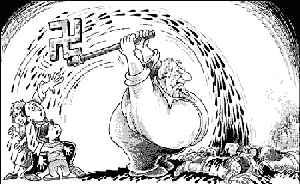
Motion Picture Association of America Logo
Cute entry from BoingBoing -- someone re-worked the Motion Picture Association of America's Logo a little bit. From BoingBoing:Fan-created MPAA logo remixHeh...
Huh. This image reminds me of... something... I've seen... somewhere... before. If only I could remember. [shrugs]. Link (Thanks, anonymous fan of the Motion Picture Association of America's logo)

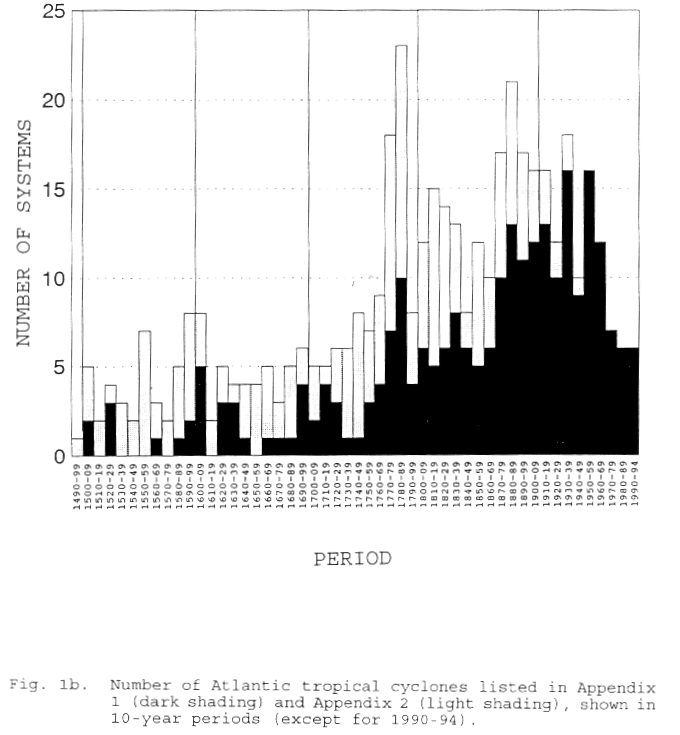



Global Warming -- the back story
Last week, James Hansen, director of NASA's Goddard Institute for Space Studies dropped this little bombshell:"Researchers calculated that 2005 produced the highest annual average surface temperature worldwide since instrument recordings began in the late 1800s"However, according to this article at LiveScience:
Conflicting Claims on Global Warming and Why It's All MootBut then we come to this:
"Nine of the 10 warmest years on record have occurred since 1995."
—Statement issued Monday by NOAA
A widely reported study last week said 2005 was the warmest on record. But headlines failed to note that the results were not concrete and a new study out this week challenges the findings.
Whatever the outcome, scientists say it is all moot: Last year was surprisingly warm and the record will fall soon enough.
The latest result came Monday from the National Climatic Data Center (NCDC), which is part of the National Oceanic and Atmospheric Administration (NOAA). These are the folks that run the National Weather Service. Their study concludes that the global temperature in 2005 can't be statistically distinguished from the record set in 1998.
Lost in many of the headlines, however, was this quote from the report's lead researcher, James Hansen, director of NASA's Goddard Institute for Space Studies: "We couldn't say with 100 percent certainty that it's the warmest year, but I'm reasonably confident that it was."And then, there is this:
Hansen looked at different data in different ways compared to the NOAA team. The NASA study considered in particular data from the Arctic, which is warming faster than the rest of the planet. And for the latter part of 2005 both reports relied on preliminary data, so the analyses could change.
In an email interview yesterday, Hansen reiterated his caveat.
"I believe that 2005 is the warmest year, because the main source of difference is the Arctic, and I believe it is likely that our estimate there is in the right ballpark even though it is based on some extrapolations," Hansen said. "However, I admit that it could be wrong, in which case 2005 might be slightly cooler than 1998."
In fact the NOAA analysis yielded two results: One data set, in use since the late 1990s, found that 2005 was slightly cooler than 1998, with 2005 being 1.04 degrees Fahrenheit above the 1880-2004 average, while 1998 was 1.12 degrees above that norm.So depending on the model you choose, it's either warmer or cooler. Want to follow an agenda, just choose your model. One of their key bits of 'evidence' was the melting of the Arctic Ice pack. It would be good if they would check their historical records a bit better. In this post, I wrote:
The other NOAA data set and analysis technique (which will become the primary method used henceforth) puts 2005 slightly warmer than 1998. It has 2005 at 1.12 degrees above the norm and 1998 at 1.06 degrees above the norm. But the report states that "uncertainties associated with the various factors and methodologies used in data set development make 2005 statistically indistinguishable from 1998."
Arctic Ice Pack meltingAnd the warming of the Arctic is publicized while the cooling of Antarctica is not -- from Nature:
There was a big outcry over the discovery that parts of the Arctic Ice Pack were receding. The environmentalists used this opportunity to shove yet another righteous sermon about “Global Warming” down the throats of the unbelievers.
Only it turns out that the Arctic Ice Pack has been going through regular cycles of advancing and receding — from The Scotsman:Polar history shows melting ice-cap may be a natural cycle
The melting of sea ice at the North Pole may be the result of a centuries-old natural cycle and not an indicator of man-made global warming, Scottish scientists have found.
After researching the log-books of Arctic explorers spanning the past 300 years, scientists believe that the outer edge of sea ice may expand and contract over regular periods of 60 to 80 years. This change corresponds roughly with known cyclical changes in atmospheric temperature.
East Antarctica puts on weightIf they make a big pronouncement, they should make one based on ALL of the data, not just a set that meets their priorly conceived agenda.
Increased snowfall over a large area of Antarctica is thickening the ice sheet and slowing the rise in sea level caused by melting ice.
A satellite survey shows that between 1992 and 2003, the East Antarctic ice sheet gained about 45 billion tonnes of ice - enough to reduce the oceans' rise by 0.12 millimetres per year. The ice sheets that cover Antarctica's bedrock are several kilometres thick in places, and contain about 90% of the world's ice. But scientists fear that if they melt in substantial quantities, this will swell the oceans and cause devastation on islands and coastal lands.