April 27, 2005
An air delivery alternative
Want to raise or lower something very carefully from the air but don't have a helicopter handy? Do what Nate Saint did in 1956 with a small plane -- here is an illustration. (The original is huge and I have reduced the resolution for faster downloading. The original is here)
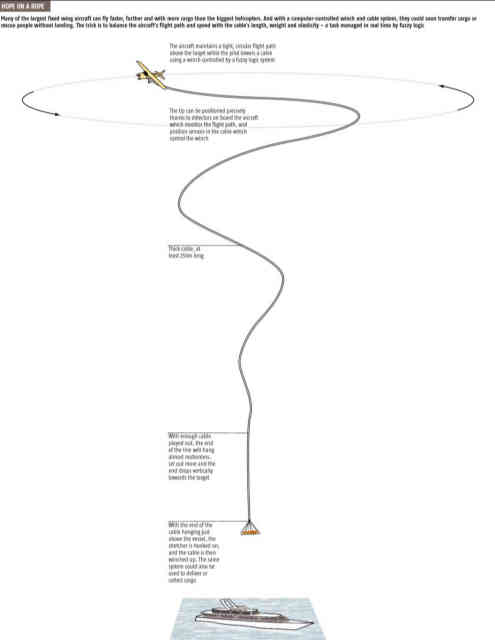
Click for full-size Image
ECUADOR, 1956. A small aircraft skims dangerously low over the rainforest, making tight circles above a narrow canyon. The pilot is Nate Saint, a missionary from the Mission Aviation Fellowship. He wants to show the Waodani people in the remote settlement below that he is friendly. Gifts are a universal language. Now all he has to do is drop them into a small clearing.And today:
Keeping one hand on the joystick, he reels a basket loaded with machetes and cooking pots out of the plane on a long line. When enough rope is paid out, Saint's tight circular flight path combines with the forces of gravity and drag to hold the basket almost motionless in the air. He lets out more line, lowering the basket until it hovers a metre above the ground.
Although Saint's "bucket drop" technique, perfected over the orange groves of California, proved invaluable for making contact, it has been largely ignored - until now.Very cool, simple idea. DOH! Posted by DaveH at April 27, 2005 10:36 PM
Almost 50 years after Saint's flight, Pavel Trivailo and a team of engineers at the Royal Melbourne Institute of Technology in Australia are exploring the same basic principles to devise a more sophisticated air delivery system. They are working on an automated device that will allow them to pick up and put down loads - including people - with hardly a jolt. If their system is successful, it could speed up rescues at sea, make cargo or aid delivery far easier and help collect injured people from otherwise inaccessible regions of jungle or mountain.
Of course, helicopters have been successfully performing all these tasks for decades. So why bother developing an alternative now?
The problem is that helicopters have limited range, speed and cargo capacity. A Lockheed C-130 transport aircraft, for instance, can carry twice as much cargo, fly three times as fast and travel five times as far as the biggest helicopter. This could make a major difference when performing a rescue or trying to reach a remote disaster site. In war zones the complex rotor systems of helicopters make them more vulnerable than fixed-wing planes. And since rotors generate limited lift, helicopters cannot fly to high altitudes where the air is thin.